An edited version of a talk to the Tyneside Circle in November 2015. Bernard Robinson examines the early historical evidence of how the Apostles formed the Church after the crucifixion, how the concept of the ekklēsia developed, and how Christianity separated from Judaism after AD 70.
An edited version of a talk to the Tyneside Circle in November 2015 by Bernard Robinson
Introduction
After the disaster of Jesus Christ's crucifixion and death, but also the inspiration of his temporary miraculous reappearances, the Apostles and other followers regrouped themselves so successfully that they became in due course a mighty Church. Bernard Robinson examines the early historical evidence of how this was achieved. He discusses how the concept of the ekklēsia became wider and in due course Christianity separated from Judaism after AD 70.
Jesus and the Kingdom
Alfred Loisy, the high priest of Modernism, wrote in 1902: "Jesus preached the Kingdom of God; but what came about was the Church."1 Whether we should make a total disjunction between the two terms, Kingdom and Church, is uncertain, as we shall see, but what is clear is that what Jesus regularly spoke about—it was the very centre of his preaching—was the Kingdom of God. This meant "a future age of glory, when God's sovereignty would be revealed in the world in the affairs of men…The land of Palestine will…form the centre of the new Kingdom."2
That was the point of the petition: "Thy Kingdom come, thy will be done on earth, as it is in heaven." Jesus had no plan to found a Church in the sense of a mixed Jewish-Gentile movement outside Israel; he had been sent, he said, "only to the lost sheep of the house of Israel" (Matt. 15:24). His disciples were to be a "little flock" (Luke 12:32; cf. Matt. 26:31; Mk. 14:27; Jn. 10:1), a group of wedding guests (Mk. 2:18-20), a reform movement within Israel. "As far as one can ascertain", says C.C.Rowland, "Jesus did not envisage a religious system independent of Judaism. He may have prepared for the existence of a sect within Judaism as a temporary measure during the short period before the kingdom of God came, by delegating his authority to preach and act on God's behalf to his followers."3
That Jesus, at least towards the end of his ministry, did not expect the immediate coming of the Kingdom is suggested by his institution of the Eucharist. Admittedly, Mark's version of the Last Supper is a farewell meal, with no command to repeat the action (Mk. 14:22-26), but the account, ten years or so earlier, in 1 Corinthians does have the command, over both elements (1 Cor. 11:24-26). Jesus chose the Twelve as "the faithful remnant of the twelve tribes, the first-fruits of the people of God called to be part of the dawning kingdom of God."4 They would sit on twelve thrones judging the twelve tribes of Israel. (Matt. 19:28; Luke 22:29-30; contrast 1 Cor. 6:2, where the saints will judge the world.) Gentiles could, however, apply to join as proselytes, as foretold by the prophets (e.g. Isa. 2:2; 60:3; 66:19-21; Jer. 16:19).5
In the Gospels there are only two occurrences of the word ekklēsia, church, both in Matthew: 16:18 ("On this rock I shall build my ekklēsia"); 18:16-17 ("If your brother sins [against you], tell the ekklēsia…if he should refuse to hear the ekklēsia…"). The 16:18 text may derive from a saying of Jesus about rebuilding the Temple, in the sense that his disciples would form the eschatological, Jewish messianic community.6 "Jesus' thinking on this matter will be similar to that of the Qumran covenanters who saw their community as superseding the Jerusalem temple."7 (So too perhaps 1 Enoch 90:20.) Matthew's ekklēsia in Matt.16 can reasonably be taken as a fair gloss. If the Matt. 18 text goes back to a saying of Jesus, he may have been speaking of the local Jewish synagogue,8 or of a local Jewish congregation. There must be a strong suspicion, however, that 18:15-20 is a Matthaean creation, an attempt to provide a disciplinary code for the Church of his day. The evangelist will have been trying to say what sort of mechanism Jesus would have devised for conflict-resolution among Christians.
The Church
When we read the writings of Jesus' followers and disciples, we find them very seldom mentioning the Kingdom, but frequently using the word ekklēsia, usually in the sense of a local assembly, but sometimes in a universal sense (Church rather than church, if you like). Why did they come to speak of themselves as Church? The word ekklēsia (√ ek-kalein, to call forth, call out), is not a Christian (or even an OT Greek) coinage. It primarily denoted the Greek legislative assembly, a parliament one may almost say (occasionally it denoted business meetings of clubs). In the Greek OT, it is often used to translate qāhāl, one of the two main Hebrew words for assembly (the other is 'ēdah). The fact that it was used in the LXX for Jewish religious assemblies may have helped its adoption as a technical term for the Christian movement; but, as we shall shortly see, this is by no means clear. Its secular usage may be a sufficient explanation for its adoption by Christians, especially Hellenistic Christians.
Since qāhāl is regularly translated ekklēsia in the Greek OT, many have argued that the early Christians had the Hebrew term very much in mind when they spoke about the church. This seems unlikely. Qāhāl (√ qhl, to gather people together, to assemble them) tends to mean primarily (a) the assembling of a group of people for a specific purpose, and secondarily (but more commonly) (b) the membership of such a group.9 Among examples of (a), I would include the texts speaking of "the day of gathering" at Horeb/Sinai: Deut. 9:10; 10:4; 18:16. When, however, Deut. 5:22 speaks of the whole qāhāl at that mountain, the word probably means the people assembled there (sense b).
Many scholars think that the word qāhāl can often refer to Israel as an organised body. It is remarkable, if this is correct, that we never hear of rulers, elders or princes of a qāhāl, only of an 'ēdah (e.g. Exod. 16:22; Lev. 4:15; Josh. 9:15). In several texts, various categories of people (eunuchs, bastards, Ammonites and Moabites) are excluded from the qāhāl of YHWH (Deut. 23:1-8; Neh. 13:1; Micah 2:5), and it is often suggested that these texts must be using the phrase of the people of God. The fact, though, that the precise formulation, stating that these people shall not enter the qāhāl of YHWH, will indicate that "the exclusion was from a service of worship, doubtless a temple-service…It will be remembered that 'foreigners' were excluded from all but the outer courts of the second temple."10 Lam. 1:10 is instructive in this regard: it says that Gentiles, who are forbidden to enter the qāhāl, have invaded the sanctuary.
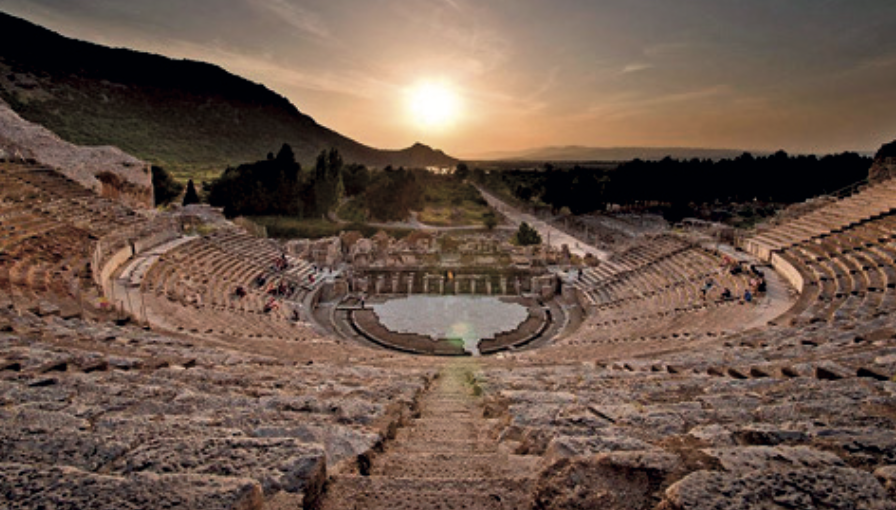
The Grand Theatre of Ephesus
Qāhāl, then, does not refer to a standing body. The other Hebrew word mentioned, 'ēdah, does. Its composition is indicated in Num. 1:2-3, "the whole 'ēdah of the sons of Israel, every single male from twenty years upwards, everyone in Israel able to go to war." It will have constituted a form of primitive male democracy, like the Mesopotamian puhrum. It will have been "responsible for waging war, hearing legal cases, punishing certain transgressions, and attesting important events in the life of the nation." (TDOT 10:479)
That such a body (which excluded women and children) was thought of as a precedent for the Christian church is not very likely. It is remarkable, in fact, that Christians seldom if ever quoted OT texts using either qāhāl or 'ēdah to point up OT precedents for the Christian Church. Acts 7:38 may be an exception. Here Stephen says of Moses: "He is the one who was in the ekklēsia in the wilderness with the angel that was speaking to him on Mount Sinai, and with our fathers. He gave us living oracles." The point of "in the ekklēsia" is not clear, but it may be that it is: "Moses was in the old congregation or church, Heb. qāhāl, Greek ekklēsia, as Christ is in the new."11 This is by no means certain, since Acts seems never to use ekklēsia of the universal church. With this possible exception, the NT seems uninterested in trying to connect the idea of the Christian church with OT texts using qāhāl and/or 'ēdah. To suppose, therefore, that Christians adopted the word ekklēsia because of OT usage of these terms is pretty speculative.
Church local and Church universal
The earliest NT texts to be written that contain the word ekklēsia are all Pauline. In the indisputably Pauline letters, ekklēsia seems always, in my view, to mean the local church or a local church meeting, even in, for example, 1 Cor.12:28 : "God has appointed in the ekklēsia, first apostles…" This is often taken to refer to the universal church.12 But, says J.D.G. Dunn, "that interpretation involves the anachronistic assumption that 'apostles' was already perceived as a universal office.
"In contrast, Paul's perception was of apostles appointed to found churches (1 Cor. 9.1-2), limited in the scope of their commission (2 Cor. 10.13-16), so that each church properly speaking had its own (founding) apostles—just as it had its other ministries of prophets, teachers, and other charisms. In 1 Cor. 12.27-28, in particular, it is evident that Paul had in mind the church of Corinth as such: 'You [the Corinthian believers] are Christ's body [in Corinth], and individually parts of it. And those whom God has appointed in the church…'".13
Also in Rom 16:23 the local church is probably meant: "Gaius who is host to me and to the whole church"-- of Corinth. The text could, though, as noted by J.C. O'Neill, mean that Gaius "willingly gave hospitality on the congregation's behalf to all Christian travellers who were passing through (Lagrange)."14 It seems more natural, though, to suppose that Paul means that Gaius made welcome in his house Christians from all the house-churches in Corinth (from where Paul was probably writing). In 1 Cor. 14:23 "the whole church" definitely means the local, not the world-wide, church. Dunn writes that "Paul's conception of the church is typically of the church in a particular place or region. He does not seem to have thought of 'the church' as something worldwide or universal—'the Church'."15
Colossians and Ephesians do use the idea of the universal Church: Col. I:18,24.; Eph. 1:22; 3:10; 3:21; 5:23-32. (Col. 4:15,16 uses the word of the local church.) Both letters are late so that, even if one or both should be Pauline, they are evidence of the late development of this notion. Both letters give the Christian community as a whole a cosmic dimension within "the mystery of Christ." All barriers between Jew and Gentile, and between nation and nation, have been broken down. Christ is the head of the Church, which is his body. For 1 Corinthians and Romans, Christians make up one body in Christ (1 Cor. 6:15; 10:16,17; 12:12-27; Rom. 12:4-5) but the notion of Christ as head of the body is peculiar to Ephesians and Colossians (Eph. 1:22; 4:15; 5:23; Col. 1:18; 2:19). (Contrast 1 Cor. 12:21, where the head is a human member of the body.)
Patterns of Ministry in the NT Church
How Jewish Christians organised themselves, is unclear. In the Gentile churches, Paul saw himself as the permanent authority figure. Many church members of both sexes exercised ministerial functions in the various congregations, but it is doubtful whether (pace Acts 14:23) any of them (except perhaps at Philippi: Phil.1:1 ) had a set sort of office to which they had been appointed. Certainly at Corinth the impression we get from 1 Cor. 14 is that people of both sexes got to their feet to sing, teach, give a revelation, speak in tongues, or interpret tongues, as they felt called to do. (The women, though, had to cover their heads, as was customary: 11:15.)
Paul's only requirement was that they must not all perform at once, otherwise their ministry would be in vain. The sort of "disarray" (14:33) that such a charismatic church order could produce may be the reason that towards the end of the first century, on the evidence of Acts, 1 Timothy, Titus, and perhaps 1 Peter, a more institutional form of church ministry emerged. However, quite late on in the first century and beyond, though, some parts of the church, such as the Johannine community and the community of the Didache, were still unhappy about increased institutionalism. In the Fourth Gospel, the charismatic Beloved Disciple always outshines the more institutional figure of Peter. In the Didache, the Eucharist is celebrated by prophets (10:7), and readers are told to let episkopoi and diakonoi share in the ministry of the prophets!
The Church and Israel
What continuities did the NT Christians see between the Christian people and Israel? Some scholars think that Paul saw the Christian community as a replacement for Israel. In Gal. 6:16 Paul, speaking of all who follow the thinking that he is expounding, says, "Peace be upon them, and mercy, and upon the Israel of God." John Bligh contends that "'the Israel of God' means the Christian Church", the true Israel, Israel according to the Spirit as against 'Israel according to the flesh'" (1 Cor.10:18).16 Dunn, however, argues, more convincingly to my mind, that for Paul the new movement was not thought of as separate from Israel but as included within it; Israel remained the recipient of God's covenantal blessings (Rom. 9:4-5). Gal. 6:16 will therefore invoke blessings on the whole of Israel, including the Christian movement, which in Paul's day had not yet been differentiated from Judaism as a separate world religion.17
"The parting of ways between Judaism and Christianity", says P.S. Alexander, "only takes on an air of finality with the triumph of Rabbinism within the Palestinian Jewish community and the virtual disappearance of Jewish Christianity;"18 in other words, in the period after AD 70. After the Fall of Jerusalem, Judaism became much less pluralistic, diverse and tolerant of rival interpretations than hitherto. A curse against Christians and other deviants was incorporated into the Jewish liturgy. As Christians saw things, however, the Christian movement was in continuity with the Israel of the OT, the people who on "the day of the qāhāl" had been summoned to Sinai/Horeb, there to hear the word of God and to commit itself to obey it under a solemn covenant and to receive the blessings promised to the patriarchs. Election, the divine presence, the covenants, the giving of the law, liturgical worship, and the promises (Rom. 9:4), God's gifts to Israel, belong, they believed, to all those who, by faith, are to be reckoned the offspring of Abraham.19
Christians, like Israel—like the rest of Israel, we should perhaps say-- saw themselves as the elect people of God. They had a new covenant which, however, did not invalidate the old one made with Israel (Rom. 11:1-2). They, like Israel, were called to pursue holiness (the commonest NT word for Christians is "saints" [hagioi], Rom. 1:7, &c., &c.), but now it was defined not in ritual but in ethical terms. They did not feel bound by the Mosaic Torah (after all, argued Paul, it was a divine afterthought which did not go back to Abraham's time: Gal. 3:17-29).
They made much of the idea of atonement, but for them this had nothing to do with Yom Kippur but with the death of Jesus Messiah. They (perhaps Paul specifically) introduced the doctrine of justification by faith. They had a non-Jewish missionary orientation, and soon became a predominantly Gentile movement. There was much that the Christian ekklēsia had in common with Israel as a whole, but there was much that was new too.
Conclusion
Jesus proclaimed the coming of a Jewish Kingdom, with, probably, Gentile proselytes joining in. Latterly, at least, he seems to have envisaged a period before the final coming of the Kingdom when his disciples would form a reform movement within Judaism. From at least about AD 50, Christians came to use of themselves the word ekklēsia, originally in a local sense but later of the universal Church. That they were influenced in this by OT words for assembly, qāhāl and 'ēdah, is far from certain. Until AD70, Christianity remained part of Israel, though with a number of important new emphases.
The Church initially was largely charismatic in nature, but towards the end of the first century institutional structures came to predominate in many, though not all, parts of the Christian world.
Bernard Robinson, Tyneside Circle
Bernard Robinson was Head of Religious Studies at St Mary's College, Fenham, Newcastle upon Tyne, where he taught from 1967 till its closure in 1985; and later (1986-1999) Lecturer in Sacred Scripture at Ushaw College, Durham.
References
Bligh, J., Galatians. London, St Paul Publications, 1970.
Brown, S., The Origins of Christianity. A Historical Introduction to the New Testament. OUP, 1984.
Bruce, F.F., The Acts of the Apostles. The Greek Text with Introduction and Commentary. London, Tyndale Press, 1951.
Campbell, J.Y., "The Origin and Meaning of the Christian Use of the Word ΕΚΚΛΗΣΙΑ", Journal of Theological Studies 49 (1948) 130-142.
Dunn, J.D.G., ed., The Partings of the Ways between Christianity and Judaism. London, SCM, 1991.
Dunn, J.G.D., The Theology of Paul the Apostle. Edinburgh, T & T Clark, 1998.
Loisy, A.F., L'Evangile et l'Eglise. ET The Gospel and the Church. Philadelphia, Fortress, c.1976.
Marshall, I.H., Acts, an Introduction and Commentary. Leicester, IVP, 1980, repr. 1989.
ODCC=Oxford Dictionary of the Christian Church, 3rd ed., ed. By E.A.Livingstone, OUP, 1979.
O'Neill, J.C., Paul's Letter to the Romans. Harmondsworth, Penguin, 1975.
Robinson, B.P., "Peter and His Successors: Tradition and Redaction in Matthew 16.17-19", Journal for the Study of the New Testament 21 (1984) 85-104.
Rowland, C.C., Christian Origins. London, SPCK, 1985.
Schmidt, K.L., The Church (Bible Key Words). London, Black, 1950.
TDOT=Theological Dictionary of the Old Testament. (eds. G.J.Butterweck & H.Ringgren). Grand Rapids, Eerdmans, c.1974-
Williams, C.S.C., A Commentary on the Acts of the Apostles. 2nd ed., London, Black, 1964.
- Loisy, 166.
- Rowland, 133-34.
- Rowland, 153.
- Rowland, 152.
- The institution of the Twelve did not survive very long, partly perhaps because it was "an early casualty of the failure of the expected imminence of the kingdom" (Brown, 134) and partly because alongside the Jewish Christian church which was struggling to survive (with James, after Peter's departure from Jerusalem, as director of the Jerusalem congregation and Peter as the leader of missionary activities to the Jews [Gal.2:7]), the Gentile Christian mission under Paul rapidly outstripped it.
- See Robinson, esp.90-93.
- Robinson, 93.
- So Schmidt, 50; Robinson, 93.
- "A gathering focussed on a currently unfolding occasion": TDOT 12:554.
- Campbell, 135-136.
- Williams, 108. Similarly Bruce, 172: "As Moses was with the old Ecclesia, so Christ is with the new, and it is still a pilgrim Church, 'the Church in the desert.'" Bruce notes that the verse following Deut. 18:15 refers to "the day of the qāhāl on Horeb." See also Marshall, 143.
- E.g. by ODCC, 344.
- Dunn 1998, 540-41.
- O'Neill, 259.
- Dunn 1998, 540.
- Bligh, 493-94.
- Dunn 1998, 507.
- P.S.Alexander in Dunn 1991, 24.
- 1 Peter ch.2 applies to Christians several OT designations for Israel (a chosen race, a royal priesthood, a holy people…) without saying that the church now has replaced Israel.