John Mulholland explores the English Reformation — its causes, its catastrophic effects, and how Catholics and Anglicans should now view this longstanding wound in the Christian body, with cause for hope in the remarkable improvement in relations between the two churches.
"How should we now view the English Reformation?" is surely a question which all present day Christians, but especially Catholics and Anglicans, must seek to answer honestly and humbly. But, if we are to do so, we must first answer other, related questions. What was the English Reformation? When did it occur? Why did it occur? And, in particular, what effects did it have, including down to our own times?
On October 31st last year events across Europe marked the 500th anniversary of the appearance of Martin Luther's 95 theses. Their effect was incendiary and the resulting Protestant Reformation spread across northern Europe like a forest fire at the end of a long, dry summer.
But it did not – emphatically not – in England. There had been Christians in what is now called England from as early as the third century – witness the martyrdom of St. Alban. But it was after St. Augustine's arrival in Canterbury, and St. Aidan's on the Holy Island of Lindisfarne, that the Faith became widely and deeply established. By the tenth century Archbishops of Canterbury were travelling to Rome for their investitures.
During some four hundred years a unique period of faith-fuelled creativity and enterprise transformed the land. Great cathedrals rose in the cities, great abbeys and smaller priories appeared in the countryside and parish churches were founded in every town and village. At the heart of the daily spiritual life in all of them was the Mass and, integral to it, faith in the Real Presence of Christ in the Eucharist.
By Luther's time the English were deeply and staunchly Catholic – and none more so than the King, Henry VIII. Luther's 95 theses brought fierce and immediate condemnation. Henry ordered that copies be seized and publicly burnt at St. Paul's Cross. He ordered theologians, notably John Fisher, his late grandmother's chaplain, now bishop of Rochester, and the greatest Catholic theologian in Europe to write works rebutting Luther's thinking.
Henry himself joined the fray, writing his Defence of the Seven Sacraments, a work which so pleased the Pope that, in 1521, he awarded Henry the title Defender of the Faith, that being of course defender of the Catholic faith. (It is one of the many great ironies of English history that successive monarchs have proudly borne that title, displaying the abbreviation Fid. Def. on the coins of the realm, after having, at their coronation, sworn to uphold the Protestant, reformed religion.)
Everything changed dramatically, not because of Luther, but because of Henry's wandering eye. One of his mistresses was Mary Boleyn, but Henry's eye later fell on her sister Anne. She, however, made clear that he could only bed her if he wed her. The result was "the king's great matter" when for six years Henry failed to rid himself of Catherine, his wife since 1509, until in 1533 he secretly married a pregnant Anne. Cranmer, by this time Archbishop of Canterbury, proclaimed Henry and Catherine's marriage to have been a nullity. A year later Henry enacted a measure which changed forever the course of English history. The Act of Supremacy declared that Henry was and always had been 'supreme head of the church in England' an action contrary to his coronation oath that the Church should be free.
Henry's claim was preposterous and, given his professing a decade earlier "all the Church of Christ over the past 1500 years has believed"1 constituted the greatest volte face in English history. But when a tyrant tells you to comply or be put to death in the most excruciating manner, it takes courage of heroic proportions to refuse.
First to show such courage were those men of prayer and peace, the Carthusians of the London Charterhouse. In what has become an iconic moment, Thomas More, former Chancellor of England, now a prisoner in The Tower of London, observed them from his cell being led in chains to their execution. There they were hanged, taken down while still alive, their entrails drawn out and their bodies torn into four quarters. One quarter of Prior John Houghton's body was then taken and nailed to the great door of the Charterhouse to demonstrate the fate of those who did not submit to the King.
Henry was determined that two men of the highest reputation in England and throughout Europe should conform. When John Fisher refused, Henry held him in the Tower for twelve months to break him. It did not. Fisher was beheaded, and soon afterwards Thomas More suffered the same fate, famously saying just before being beheaded "I die the king's good servant, but God's first".
Desecration and sacrilege
That Act of Supremacy was the moment when what is now the Church of England was conceived – though it was to have a decades-long gestation period – and when the English Reformation began. (I use the conventional term "reformation" though it is a misnomer; "revolution" would be closer, not of the people but enforced on them.) The Suppression of the Monasteries followed and ancient religious houses were plundered, as were the shrines at Canterbury, Walsingham and Durham, their valuables seized for the king, their monks and nuns evicted. It was, in David Starkey's words, "desecration and sacrilege on a massive scale".2
A great rebellion, known as the Pilgrimage of Grace, arose against Henry's actions. A force of 30,000 could have routed the king's force of 5,000 and dictated terms but they believed Henry's assurances – and paid for their trust with their lives. Their leader, the principled Robert Aske, was hanged in chains high above Clifford's Tower in York, taking six days to die. Henry clung to his fantasy that the Church remained Catholic and made denial of transubstantiation punishable by death. But the reality was that England had been made a country of religious totalitarianism enforced with a barbaric savagery which was to continue for more than 150 years.
After Henry's death in 1547 nine-year-old Edward VI introduced Calvinistic Protestantism stating "the pope is the son of the devil and the anti-Christ". An orgy of destruction took place – statues were broken, stained glass windows smashed, wall paintings whitewashed over, roods pulled down and their statues of Christ, His mother and St John were burned; the Mass was outlawed and guilds abolished. It was "a cultural revolution designed to obliterate England's memory of who she was and who she had been".3 Those who held on to the old faith must have been in despair; the Mass which they loved was derided and the reserved sacrament scorned as "little God in a box".
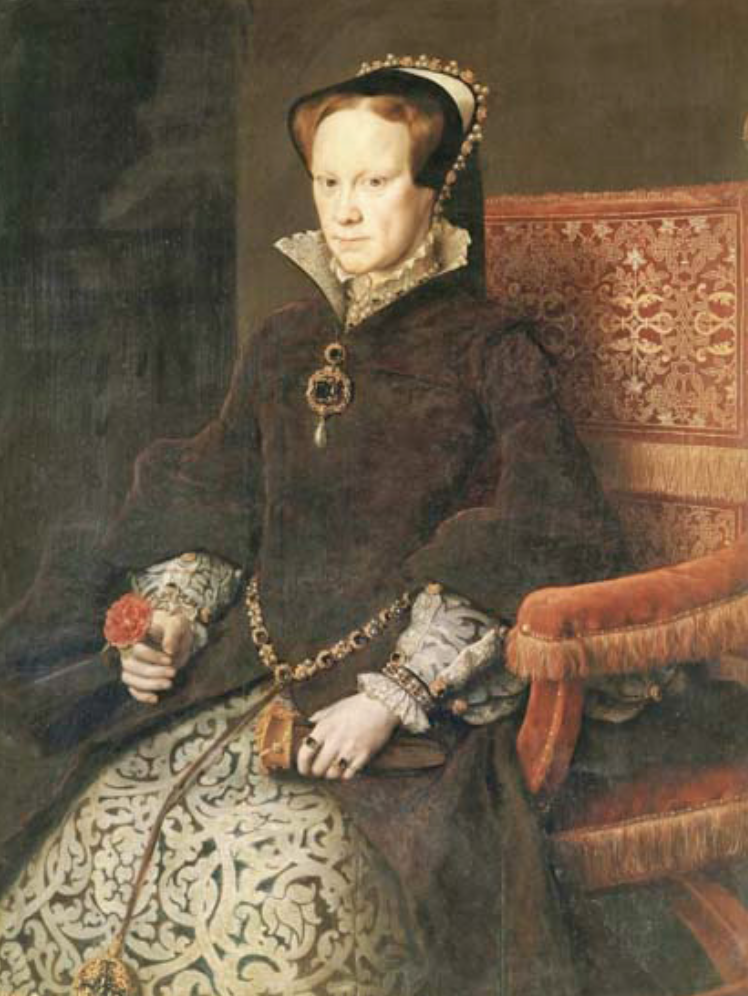
Then everything changed. Edward died in 1553 succeeded by the Catholic Mary, daughter of Queen Catherine. Her reign began auspiciously from a Catholic perspective. A treasonous attempt to deny her the crown failed and Mary rode into London greeted by cheering crowds. Parliament restored Catholicism and the Pope as head of the Church. Mary then made fateful misjudgements. She married Philip of Spain and not an appropriate English suitor. She might have followed the example of her namesake and first cousin, Mary Queen of Scots, who, though staunchly Catholic, tolerated Calvinistic Protestantism in her realm, but instead she revived the heresy laws. Some 300 Protestants were gruesomely burnt at the stake including Bishops Latimer and Ridley and, most significantly, Archbishop Cranmer who had recanted but later repudiated his recantation.
In Eamon Duffy's words "the decision to burn Cranmer provoked the weary old man to a desperate last stand and a magnificently defiant death"4 for he thrust his hand into the flames announcing that it, which had signed his recantation, should be the first part of him to burn. Cranmer's death, as recounted in Foxe's Book of Martyrs, became "an iconic moment in the English Reformation"5 profoundly influencing later generations.
When Elizabeth I succeeded Mary in 1558 the English Reformation was secure and the new Church, conceived by her father, was born. Acts of Supremacy and Uniformity were passed – though only after strenuous opposition from the Catholic bishops, all but one of the twenty nine refusing the oath. The Act of Supremacy made Elizabeth supreme governor of the church in England declaring "the pope of Rome hath no jurisdiction in this realm of England". The Act of Uniformity required church services to be from the Book of Common Prayer, and that all attend their local parish church; non-attendance incurred a penalty of twelve pence, which was some two weeks' wages for a skilled workman.
One purpose of the Act was to expose and pressurise Catholics, now recusants, who faced a stark choice – apostasy or penury. They expressed their feelings in literature as in the Lament for Walsingham: "Bitter, bitter O to behold/ The grass to grow/ Where the walls of Walsingham/ So stately did show." And Shakespeare's sonnet 73 spoke of "Bare ruined quiers, where late the sweet birds sang". Few, however, conveyed their distress and bewilderment more vividly than Lady Cecily Stonor who, pressurised by the authorities to conform, responded: "I was born in such a time when Holy Mass was in great reverence and was brought up in the same faith. Now in this time it pleaseth the state to question them, as they now do me, who continue in this Catholic profession. I hold me still to that wherein I was born and find nothing taught in it but great virtue and sanctity, and so by the grace of God I will live and die in it".
The embattled recusants must have felt that their plight could not get worse, but it was to become much worse – and that because of actions taken by fellow Catholics. First the Pope, in his calamitously ill-judged bull Regnans in Excelsis, excommunicated and deposed Elizabeth, releasing her Catholic subjects from their allegiance to her. It is unlikely that Elizabeth lost any sleep over being excommunicated – after all she now had her own new state church and had been made its head. But deposing her and releasing her Catholic subjects from loyalty to her were very different matters. At a stroke the Pope caused English Catholics to be seen as potential traitors; the issues of religion and loyalty to the crown were henceforth inextricably linked.
Execution of priests
Elizabeth's reaction was swift, and savage penal laws ensued. Priests caught in England and those sheltering them were to be hanged, drawn and quartered. Over 200, priests and lay people, were executed during Elizabeth's reign. The blessing of the Spanish Armada by Cardinal Allen and his seditious act in exhorting Elizabeth's subjects to rebel, gave valid grounds for viewing Catholics as potential traitors; the Armada's defeat, portrayed as providential deliverance, turned Elizabeth into a living legend, one which has persisted to this day.
Elizabeth died in 1603, succeeded by James VI of Scotland who became James I of England. James' accession raised Catholic hopes of tolerance – travelling from Scotland he had ennobled the brother of the Jesuit, John Gerrard, the most wanted priest in England – only for them to be quickly dashed. The prospects for Catholics were bleak. The Gunpowder Plot, had it succeeded, would have resulted in the mass murder of the king, the royal family, all members of parliament and hundreds of people in the vicinity, and the placing of a Catholic on the throne. It would have been a crime without parallel in English history.
The plot was the action of a handful of desperate men who faced losing their possessions, had witnessed friends brutally executed for their faith, and saw no hope for the future; it had nothing to do with the rest of the Catholic population. But it gave further grounds, on top of Regnans in Excelsis and the Armada, for alleging the treacherous nature of all Papists. To ensure the plot should never be forgotten an Act was passed making November 5th a national celebration. Effigies of Guy Fawkes or the Pope were burnt and sermons preached thanking God for safe deliverance, thus reminding people of Catholic treachery and of the danger posed by the Catholics in their midst.
The policy of tarring all Catholics with the brush of potential traitors proved immensely successful. The Great Fire of London of 1666 began accidentally in a baker's premises in Pudding Lane but a plaque fixed to that spot 15 years later read "Here … hell broke out upon this protestant city from the malicious hearts of barbarous papists". Christopher Wren's monument, erected to commemorate the fire, contained similar, untruthful vitriol: "Popish frenzy which wrought such horrors is not yet quenched".
The first victim of propaganda is truth – but human victims can swiftly follow. In 1688 Titus Oates alleged that Jesuits were plotting to assassinate Charles II. Mob hysteria resulted, with Catholics driven from their homes, Catholic lords imprisoned and thirty-six laymen and priests executed. One priest, Nicholas Postgate, who had ministered for decades to his scattered flock on the inhospitable North Yorkshire Moors, was hanged, drawn and quartered at the York Tyburn at the age of 82. Oates, whose allegations were entirely false, was later convicted of perjury.
Further laws contributed to what F.W. Maitland called "the terrible code against Catholics"6. They were excluded from parliament, municipal office, the universities, commissions in the army and navy, teaching, litigating, from being barristers, from purchasing or inheriting land, from coming within ten miles of London, from travelling more than five miles from their abode (upon penalty of all their goods) and from keeping a horse. And if Catholics married before a Catholic priest, and not in the Church of England, their children were illegitimate. The effect of this battery of laws was to turn recusants into internal exiles and aliens in their own country.
The 1778 Catholic Relief Act gave but a small relaxation of the penal laws. It nevertheless inflamed Lord George Gordon, MP and rabid anti-Catholic, to instigate the greatest outburst of civil disorder in modern British history. In the Gordon Riots some 1,000 people were killed, Catholic chapels destroyed and Catholic houses set on fire. So pathological was the mob's mentality that they brought canaries out of Catholic homes and burnt them as "Popish birds". Catholic families resorted to putting "No Popery" notices in their windows in order to survive7.
Emancipation of Catholics
Catholic Emancipation eventually came in 1829 but only after immense opposition. George III, whose Royal Assent was required, stated that he would rather beg his bread from door to door throughout Europe than betray his coronation oath; Robert Peel, alarmed that Irish Catholics would enter Parliament, described them as "a set of human beings very little advanced from barbarism"; another staunch opponent was John Henry Newman, then busy with his friends in the Oxford Movement attempting to "re-catholicise" the Church of England.
Catholic Emancipation removed most but not all the penal laws and ended official persecution. The question remained, however, whether conferring legitimacy on Catholics would prove a sufficient antidote to the anti-Catholic venom with which English society had been deliberately infected during the previous three hundred years. The answer came swiftly and unambiguously. Following the restoration of the hierarchy Punch published a series of vicious cartoons, one portraying the Pope below the Palace of Westminster, with mitres stacked like barrels of gunpowder and the caption "The Guy Fawkes of 1850 preparing to blow up all England".
The Times, in a notorious editorial, spluttered: "The new-fangled Archbishop of Westminster signifies no more than if the Pope had been pleased to confer on the editor of The Tablet the rank and title of the Duke of Smithfield….we can only regard it as one of the grossest acts of folly and impertinence which the Court of Rome has ventured to commit since the Crown and people of England threw off its yoke".
The claim that the people threw off a popish yoke was myth masquerading as history: "Hostility to the papacy was not the cause of the English reformation, it was one of its consequences"8. Remarkably, however, in 1891 The Times' obituary of Newman struck a notably different tone: "Whether Rome canonises him or not he will be canonised in the thoughts of pious people of many creeds in England". Those words are the more noteworthy given that Newman was the most famous convert from the Church of England to Catholicism in over a hundred years and the man who, with his friends in the Oxford Movement, set part of the Church of England on the way to Anglo Catholicism.
The twentieth century saw a profound, albeit gradual, thawing in relations. The Great War showed that Catholics, far from being potential traitors, were prepared in huge numbers to die for King and Country and Catholic chaplains inspired admiration for their tending of the wounded and dying. Perhaps because of those events questions began to be asked which previously would have been inconceivable. Could the Catholic Church and the Church of England be reconciled, even reunited? Those questions were discussed by Lord Halifax, a High Church Anglican, and a French Catholic priest, the Abbé Portal, in the Malines Conversations from 1921 to 1927, with the tacit approval of the Vatican and the Archbishop of Canterbury. If only a measure of goodwill resulted at least the ice had been broken.
It was after the traumatic experience of another World War that relations between the two churches were radically changed. In 1960 a meeting between Pope John XXIII and Archbishop Geoffrey Fisher, described as merely a courtesy call, was nevertheless the first meeting between respective leaders in over 400 years and paved the way for a later, transformational meeting.
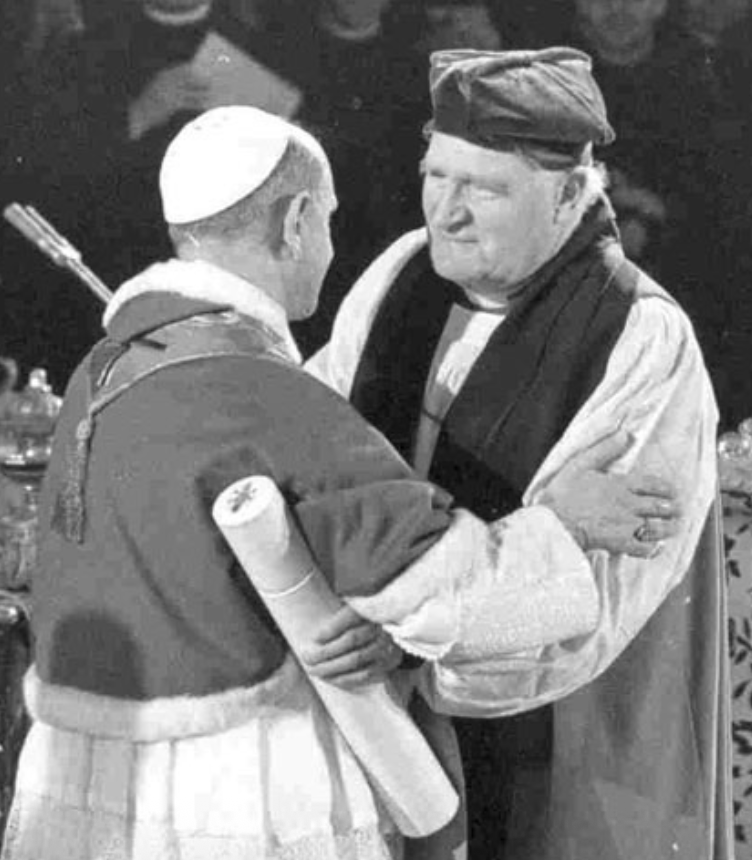
In 1966 Pope Paul VI and Archbishop Michael Ramsey met officially, exchanged rings symbolically, and inaugurated formal discussions, known as ARCIC (Anglican-Roman Catholic International Commission). The Anglican Centre in Rome was established, its head the Archbishop of Canterbury's representative to the Holy See. The recently retired head, Archbishop Sir David Moxon, has written of the search for "full, visible organic union" and has stated that there is "substantial and essential agreement on around 90% of core doctrine"9. Liturgically, also, each church has learned from the other, though the new translation of the Mass has been counter-productive.
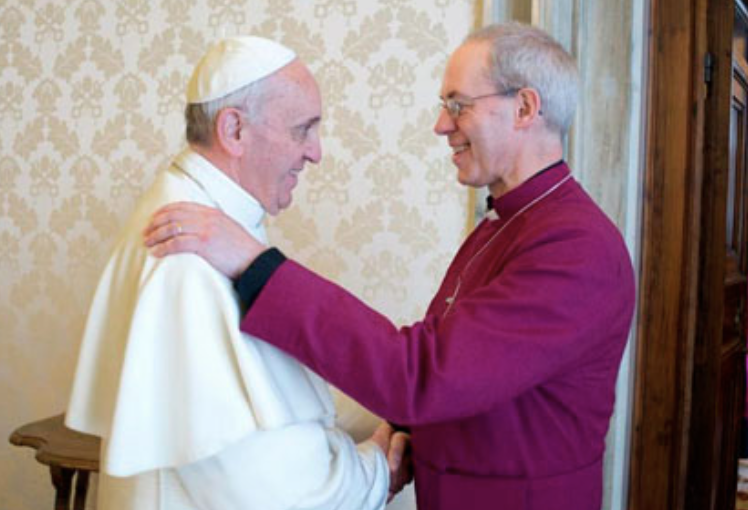
Public manifestations of this new relationship occurred when Popes John Paul II and Benedict XVI were received by Queen Elizabeth II (who referred to the late Cardinal Hume as 'my cardinal') and Pope and Archbishop of Canterbury knelt together in prayer at the shrine of St. Thomas à Becket. Recent meetings between Pope Francis and Archbishop Justin Welby have further cemented relations between the now sister churches. Yet there still lingers, in some secular circles, the view that Catholicism is alien, foreign, not really English. In an interview in The Tablet Roy Hattersley claimed: "We are not by nature a Catholic people. It is all to do with being an island race. The Reformation didn't begin because of Henry VIII's marital problems, but because England, as an island race, wanted to make its own decisions". Similarly Simon Jenkins in the Sunday Times gave the cause of the English Reformation as the people rejecting Catholicism, "an alien….. agent of intellectual oppression, awash in magic and superstition". Old attitudes – and myths – die hard.
So how should we now view the English Reformation? Clearly it was a tragedy with catastrophic effects for the hundreds, Catholic and Protestant, barbarously executed, and for the demonised Catholic community, the overwhelming majority of whom merely wished to be allowed to practise their faith in peace. It produced the scandal of Catholic and Protestant – later Anglican – churches regarding each other for three hundred years with a self-righteous, visceral hostility. Worst of all it produced executions brutally carried out by each side whilst claiming to be acting in the name of the Prince of Peace. We have all viewed the Reformation from our partisan positions with resentment and anger – and sometimes still can. But resentment and anger are not only futile and damaging but contrary to God's will. We should surely now view the Reformation as causing a longstanding, deep and shameful wound in the Christian body, the Mystical Body of Christ, a wound which it behoves us all to seek to heal. Much has been done to that end – but more healing is needed.
Two symbols give me hope. On Barrowell Hill, Chester, once a place of execution, there is a memorial stone commemorating two martyrs, one the Catholic John Plessington, the other the Protestant Richard Marsh. And in Manchester Cathedral there is a plaque commemorating the Protestant martyr John Bradford and the Catholic martyr Ambrose Barlow. Marsh and Bradford were burnt to death during the reign of Mary Tudor; Plessington and Barlow were priests hanged, drawn and quartered following the Titus Oates affair. The latter two have been canonised and are venerated as saints by Catholics. But Marsh and Bradford, too, died for their faith. Are they not also saints in heaven?
And when might we see a similar plaque in a Catholic cathedral?
Notes
- Henry VIII, Assertio Septem Sacramentorum, annex, 1521 edition
- David Starkey, BBC History Magazine, November 2017
- Eamon Duffy, Saints, Sacrilege and Sedition, Bloomsbury, 2012, p 11
- Duffy, op cit, p 190
- F W Maitland, The Constitutional History of England, Cambridge, 1968 edition, p 515
- Antonia Fraser in The King and the Catholics, Weidenfeld and Nicolson, 2018, gives a vivid account of the struggle for emancipation
- Duffy, op cit, p 9
- Archbishop Sir David Moxon, The Venerabile, 2017
This article is based on a talk given to the Manchester and North Cheshire Circle on July 10th, 2018.