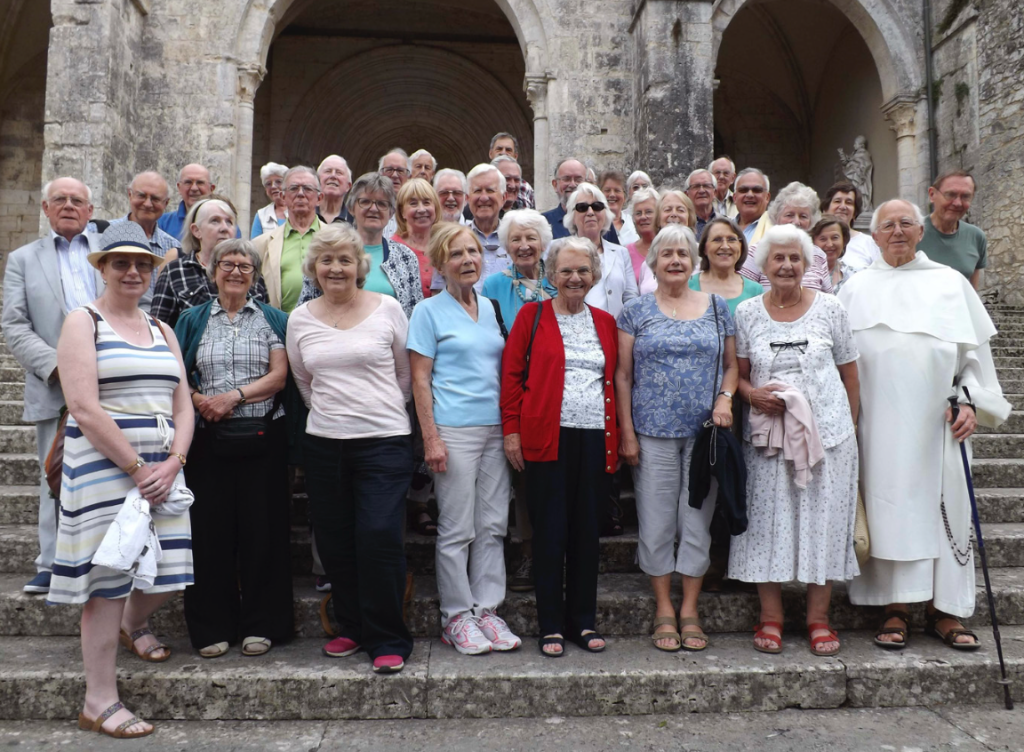
A report on the 2016 Newman Association pilgrimage, based at Villa Palazzola near Rome, visiting monasteries across the Lazio region including Monte Cassino, Casamari and Fossanova.
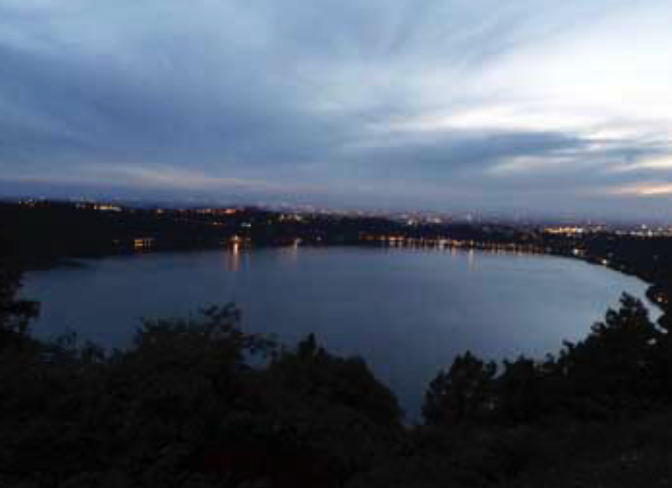
Although two couples pulled out at the last moment, for health reasons, 44 people, nearly all Newman Association members, attended the 2016 Pilgrimage; it was based at the Villa Palazzola, 18 miles south-east of Rome, between September 16th and 22nd. There were trips to a number of monasteries and other locations within the province of Lazio, together with visits to Rome itself and to the Pope's summer palace at nearby Castel Gandolfo, clearly seen from Palazzola across Lake Albano which lies within the crater of an extinct volcano.
Palazzola is the former summer residence, acquired in 1920, of the Venerable English College in Rome, which still owns it as a pilgrimage, retreat and study centre. The central cloister is evidence of the monastic origins (Franciscans occupied Palazzola for 500 years) but now there is an elegant terrace and garden, with a swimming pool.
An early problem was the cancellation of a British Airways flight on which eleven pilgrims were booked but all arrived eventually, though the welcome party had to be delayed until the following evening. On Saturday, the first morning, the group embarked upon what was to be an extended tour of monasticism in the Lazio region, starting with Subiaco; this was where St Benedict first embarked in about the year 500 on his vocation as, to begin with, a hermit and then, in due course, a community leader and developer of his famous Rule.
There were originally thirteen small communities of followers around Subiaco but what remains today is the spectacular monastery of Sacro Speco, mostly dating from the 11th century. The monastery is built on a steep hillside around the cave where St Benedict lived for about three years as a hermit. Benedict himself, however, left the area in 529 when his early model of small monasteries proved unworkable and moved instead to Monte Cassino where he devised his Rule in the context of a much bigger establishment. His principle Ora et Labora – pray and work – came to dominate monasticism for centuries. He died in 547 and is buried at Monte Cassino, which the Newman Pilgrimage reached on the Tuesday, three days later.
Today's seemingly impregnable Abbey of Monte Cassino dominates the surrounding plains from its hilltop site but it is only the latest of many reconstructions, the current edifice dating only from the 1950s after the Abbey was destroyed by Allied bombing in 1944.
The Newman pilgrims were guided into a basement area where some of the original monastery remains. Elsewhere the buildings – including the Baroque church – were on an impressive scale, but it is sad to realise that an Abbey which once housed over 200 monks has now shrunk to a community of about 30.
In the afternoon the Newman bus moved on to the more modest but still impressive Cistercian Abbey of Casamari. All the church's windows were expensively made of alabaster, though one or two members of our group complained that this made the interior very dim. One of the monks patiently informed us about the community's way of life, and although he spoke in Italian we were fortunate to have the services of our unofficial interpreter Canon Michael Cooley. Outside the Abbey a large market was doing an active trade in cabbage and leek plants, and it was clear from the Abbey's own vegetable patch that extensive planting was taking place for the winter and spring.
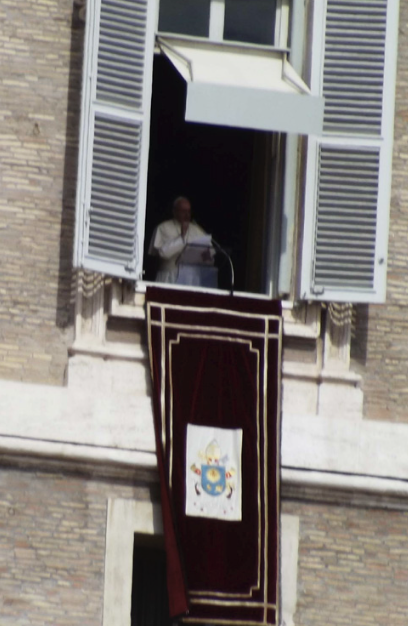
In between our days of monastic exploration we paid a visit to Rome. In acknowledgment of our temporary landlords we celebrated Mass at the Venerable English College itself, in the splendidly gold-decorated chapel. Fr Fabian, our chaplain, preached on the theme of the day's Gospel according to Luke: you cannot be the slave both of God and money. We then moved to St Peter's Square, slowed down by airport-style security checks but emerging just in time for the celebration of the Angelus by Pope Francis; he was very distant in a high window but fortunately was amplified by loudspeakers and giant video screens. After a picnic lunch in the gardens of the Villa Borghese we visited the Basilica of St Paul's Outside the Walls, where we entered through the Holy Door.
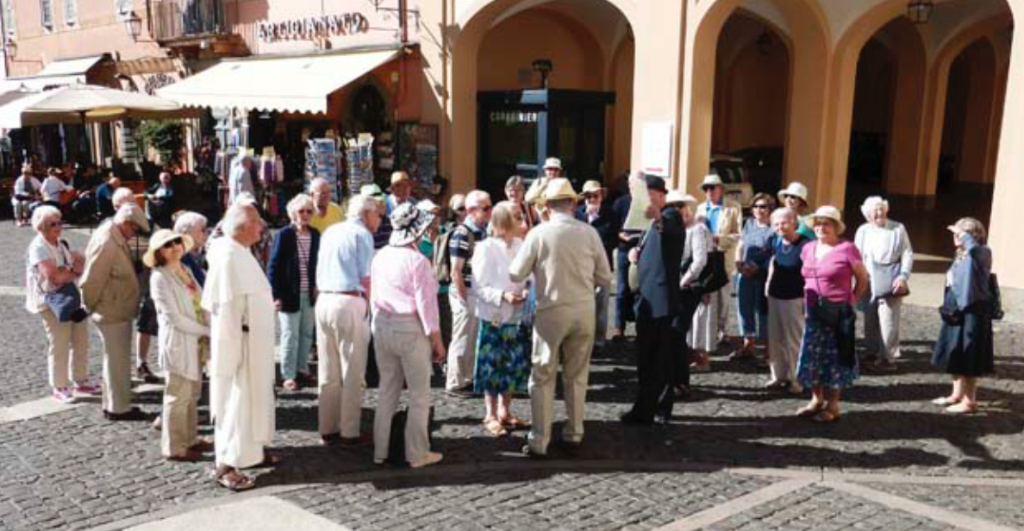
On Monday we visited Castel Gandolfo, driving around the crater rim to the village where the Pope has a summer residence. Although most of his palace, and the accompanying Vatican Observatory, is closed to the public some Newman pilgrims visited an exhibition covering the history of the papacy from 1503 to today. Others went on a guided tour of the amazing pontifical Barberini Gardens which spill down the edge of the hillside and give a wonderful view of the countryside away towards Rome. The umbrella pines were astonishing, and the gardens surprisingly turned out to have their own small Roman theatre, ideal for taking group photographs.
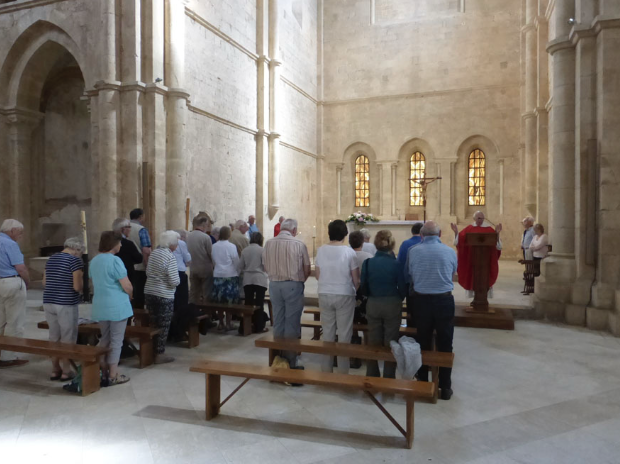
On Wednesday the bus took us to the final monastery on our list: Fossanova, which like several other Abbeys has changed hands over the centuries and although founded by Cistercians has since been taken over by the Franciscans. We celebrated Mass in the impressive church; its bare stone walls, in accordance with Cistercian principles, provided a stark contrast to the ostentatious extravagance of, for example, the rebuilt Baroque church at Monte Cassino. Fossanova is notable for being the place where the Dominican St Thomas Aquinas died while stopping over on his journey to the Council of Lyon in 1274. Several of us climbed a steep spiral staircase to the room (now a small chapel) where he is said to have met his end.
In the afternoon we made progress along the lush coastal plain to the Ninfa Gardens. Once owned by a partly-English family, this remarkable horticultural site is watered by gushing streams which spring out of the nearby limestone cliffs. Whereas Italian gardens are generally dominated by right-angled grid patterns and heavily-clipped hedges at Ninfa the trees spread naturally and there are even English-style herbaceous borders. The garden grows in and around the ruins of the old town of Ninfa, which apparently fell in the 17th century when its inhabitants backed the wrong Papal faction: that is a warning to us all.
Besides the daytime travelling we enjoyed our varied evening activities. On the Sunday Gerald Williams organised a highly cultural and varied quiz covering Italian artists, composers of operas, the first lines of English novels and much more. On Monday evening we heard Professor Maurice Whitehead, currently attached to the English College and reorganising its archives, give a lecture on the College's history when it was under Jesuit administration between 1579 and 1773.
On Wednesday we enjoyed a rather more relaxed talk from Canon Michael Cooley on St Philip Neri, who was known to the Italians as "God's jester". St Philip's style, Michael Cooley said, was "serious but with a bit of jollity". He remembered his own days at the English College, where major Church events were apparently known as functions and the seminarians regarded themselves as "function fodder". One such function would take place every May 26th, St Philip's feast day, at the Chiesa Nuova in Rome, the church where he is buried. Canon Michael therefore persuaded us to sing a comic song called A Function Tonight; its chorus ran:
With your Liber, birette and candle
Impossible to handle
Boiling wax on your cassock, and your cotta alight.
Throughout our stay we greatly enjoyed the food at Palazzola, always starting with an authentic helping of pasta (a different variety each day) or risotto, followed by a meat dish and then a comprehensive selection of seasonal fruit, including some of the biggest apples ever seen. There were endless supplies of excellent Castelli Romani wine, this being the local product grown on the hills south of Rome.
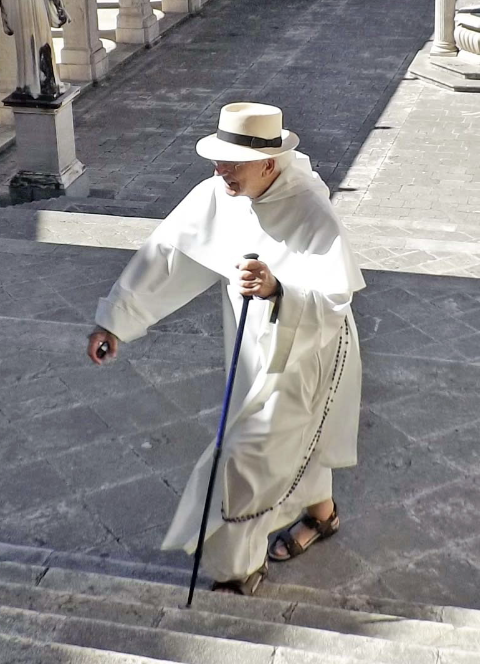
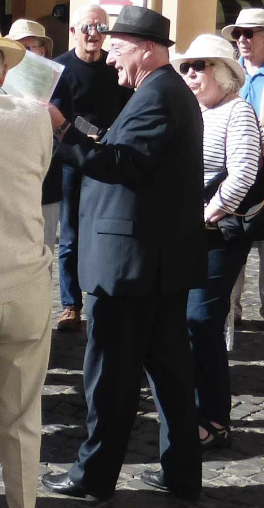
We were shepherded constantly by Fr Fabian, who said Mass in a wide variety of locations and led us in late evening recitals of the Salve Regina in the cloister. Our grateful thanks are also due to Anthony Coles who organised the pilgrimage magnificently, always counting us diligently on the bus and making sure that we reached every monastery on time. His knowledge of the location of toilets (or "facilities") was infallible and his pork-pie hat made him easy to spot and follow. On the bus he would seize the microphone and inform us authoritatively of everything from Romulus and Remus to the cultivation of Kiwi fruit, depending on our particular journey that day.