Four members of the North Merseyside Newman Circle recount their unforgettable four-day visit to Rome in March 2015, including a tour of the Venerable English College archives and a surprise encounter with Cardinal Vincent Nichols.
Four members from the North Merseyside Newman Circle, Howard Curtis, David Giles, Michael Burke and Peter Firth (who are also both Catenians), spent an unforgettable four-day visit in Rome, having organised the trip themselves for less than £275. Most importantly they were able to meet up with their chaplain, Monsignor Peter Fleetwood, who was on a six-month transfer from Oscott College to the Venerable English College in Rome.
Monsignor Peter first showed the group around the college with all of its historical significance. One of the many highlights was the visit to the archives, with artefacts dating from the mid-16th century when the former English Hospice of the Most Holy Trinity and St Thomas (1362-1579) was converted into the Venerabile Collegio Inglese. It became a seminary for Englishmen fleeing from the terrors of the Reformation. After training as priests, these brave men made their way back to England to maintain contact with the Catholic faithful, as they attempted to resist the spread of Protestantism. Many of these returning recruits found themselves adding to the ever-increasing list of English Catholic Martyrs, one of whom was St Ralph Sherwin. He appears as the first entry in the Liber Ruber, the so-called Red Book, perhaps, the most valuable item in the archive. Many of those early seminarians suffered the same fate, executed as martyrs - often the result of trumped-up charges of treason.
Being allowed access to this unique primary source of English Catholic history, the visitors from Liverpool were also able to handle a tiny late 17th century handwritten private prayer booklet from their local area – apparently the possession of a lady who, it seems, was able to slip it into her apron pocket, undetected, at a time when Catholics were still not able to practise their faith openly.
The group were told that the archive is in the process of being professionally catalogued for the first time since its inception. When completed this unique collection will provide an extremely valuable resource for historical researchers to explore over 500 years of an essential part of English Catholic history. This cataloguing has only been possible because of the generosity of a Swiss benefactor who has enabled Dr Maurice Whitehead of Swansea University and an Italian archivist to undertake this long-overdue, essential ordering of the college's records.
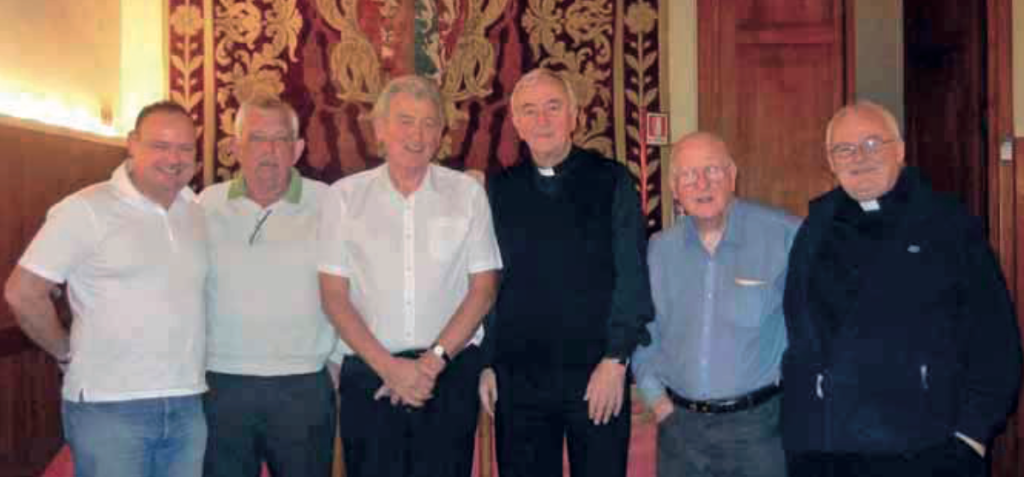
The group were invited to join the staff and current seminarians (who nowadays include men from other parts of the world, as well as England) for evening meal. Another visitor to the college that day was Cardinal Vincent Nichols who came over to talk to the four somewhat surprised guests. Cardinal Nichols was born and educated in Crosby where their Newman Circle meets and holds its talks. He spent some time enquiring as to the current range of activities, together with making suggestions for future visits to consider in relation to John Henry Newman for whose canonisation he has been an advocate. He was also Chairman of the governing body of Newman University College (now a university) in Birmingham, as well as overseeing the attempted removal of his 19th century predecessor's remains to the Oratory in Birmingham city centre in 2008. Cardinal Nichols was happy to be photographed with the group as a memento of their visit.
The meaning of Conscience
Monsignor Peter also arranged for a visit to the International Centre of Newman Friends, not far from the Vatican, where they met Sister Irene, an Austrian nun from the Order of "Das Werk". Amongst other duties she is responsible for running the library, dedicated to the study of John Henry Newman. There the group met two Indian priests and one African nun, who are engaged in research for different university degrees, including the meaning of Conscience, a matter close to the heart of the blessed cardinal. A photograph with Sister Irene recorded yet another notable part of the visit.
On its own the group visited other historic religious buildings, including the church of Scala Santa, the basilicas of Santa Maria Maggiore, San Giovanni in Laterano, Santi Quattro Coronati and San Clemente - the last of which included the current church and its underground former medieval church, both of which were built over a 2000-year-old pagan temple. With careful planning, the group managed to hear Mass in English every day at a combination of English, American and Irish services across Rome.
On their last full day, the Monsignor organised a relaxing walk. This went through the Jewish quarter of Rome where the group learnt about other parts of the city's history. Prior to the formation of the 16th century ghetto, Jewish families had often been very supportive of the papacy. In contrast, within the walled enclosure, Jews had a hard time, including being forced to hear weekly sermons as well as the Passion every year on Good Friday. However, during WWII Pius XII ordered all religious houses to take in Jewish families, with the chief rabbi of Rome becoming a Catholic after the war. Crossing the small Tiber Island, the walk took in the church of San Bartolomeo all'Isola. This is dedicated to 20th century Catholic martyrs, including victims of repression in San Salvador, Nazi Germany and many other parts of the globe. This informal tour concluded with visits to the cardinal churches of Santa Maria in Trastevere and San Crisogono with its underground palaeo-Christian basilica.
Four days of activity-packed events left the visitors from Liverpool both with memorable experiences of their trip to Rome and extreme gratitude for those who had made it so enjoyable.
Peter Firth
Chairman, North Merseyside Newman Circle