Simone Weil was not a Catholic and nor indeed technically a Christian. She was Jewish and was born in Paris in 1903.
Spirituality Page
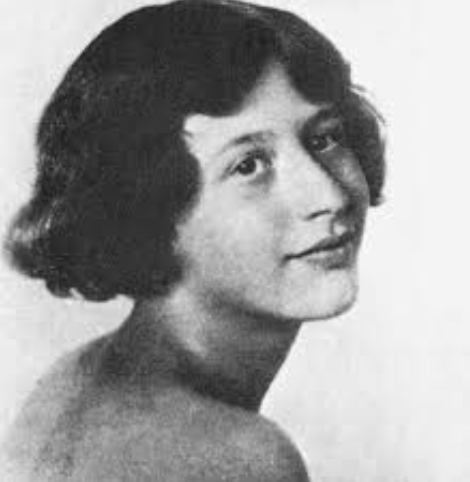
Simone Weil
Simone Weil was not a Catholic and nor indeed technically a Christian. She was Jewish and was born in Paris in 1903. She qualified in Philosophy and taught this subject in school and also took breaks to work in the fields as an agricultural labourer, to experience life on the Catalonian front in the Spanish Civil War, and to work in the Renault car factory.
In 1942 she was called on to serve the French Provisional Government and at their request she prepared a study, The Need for Roots, which dealt with the need for the French people to rediscover their real spiritual roots. She refused to take more food than the rations given to ordinary people in France and, probably partly as a result of this, died in a sanatorium at Ashford, Kent, in 1943 where, somewhat bizarrely, a bypass is now named after her.
These bald facts disguise a personality of intense spirituality and a mind of genius who was also something of a mystic. As T.S. Eliot wrote in an introduction to The Need for Roots, she "might have become a saint" but, as he then observed: "A potential saint can be a very difficult person". Her great friendship was with a Fr. Perrin, to whom she wrote what she called her "Spiritual Autobiography" and many other letters.
She was never baptised a Catholic but it was the Catholic faith to which she was strongly drawn. She wrote movingly of how she first encountered Catholicism one evening in a Portuguese village where the patronal festival was being commemorated and:
The wives of the fishermen were going in procession to make a tour of all the ships, carrying candles and singing what must be very ancient hymns of a heart-rending sadness… I have never heard anything so poignant unless it were the song of the boatmen on the Volga.
Yet something drew her back from baptism. She hints at something in this passage, where she speaks of the establishment by the Church of a "rough sort of totalitarianism in Europe" with the persecution of the Albigenses in the Thirteenth century, and in particular the words anathema sit. So she argues that:
In order that the present attitude of the Church should be effective and that she should penetrate like a wedge into social existence, she would have to say openly that she had changed or wished to change.
However, she does write movingly about traditional Catholic teaching, as in this passage on the Christian vocation:
In the state of perfection, which is the vocation of each one of us, we no longer live in ourselves, but Christ lives in us; so that through our perfection Christ in his integrity and in his indivisible unity becomes in a sense one of us, as he is completely in each host.
Anne and John Duddington