As the Year of Mercy progresses we need to think clearly and deeply about what mercy really means. Pope St. John Paul II, in his second encyclical Dives in Misericordia, considers not only the theological foundation of mercy but also its place in dealing with the challenges of modern life.
Mercy
As the Year of Mercy progresses we need to think clearly and deeply about what mercy really means. Pope St. John Paul II, in his second encyclical Dives in Misericordia, considers not only the theological foundation of mercy but also its place in dealing with the challenges of modern life.
He looks at the idea of mercy in the Old Testament and then reminds us that we are all called to the exercise of mercy; that "mercy does not pertain only to the notion of God, but it is something that characterises the life of the whole people of Israel and each of its sons and daughters: mercy is the content of intimacy with their Lord, the content of their dialogue with Him".
Not only this but when we exercise mercy it is not just a unilateral act on our part, which could easily lead to a condescending attitude by us, but a bilateral one. This is because: "In reciprocal relationships between persons merciful love is never a unilateral act or process. Even in the cases in which everything would seem to indicate that only one party is giving and offering, and the other only receiving and taking (for example, in the case of a physician giving treatment, a teacher teaching, parents supporting and bringing up their children, a benefactor helping the needy) in reality the one who gives is always also a beneficiary. In any case, he too can easily find himself in the position of the one who receives, who obtains a benefit, who experiences merciful love; he too can find himself the object of mercy".
As Portia puts it in The Merchant of Venice:
The quality of mercy is not strained,
It droppeth as the gentle rain from heaven
Upon the place beneath. It is twice blessed;
It blesseth him that gives and him that takes.
But where does the exercise of mercy leave justice? In Dives in Misericordia Pope St. John Paul II refers to: "the fundamental link between mercy and justice spoken of by the whole biblical tradition, and above all by the messianic mission of Jesus Christ. True mercy is, so to speak, the most profound source of justice. If justice is in itself suitable for 'arbitration' between people concerning the reciprocal distribution of objective goods in an equitable manner, love and only love (including that kindly love that we call 'mercy') is capable of restoring man to Himself".
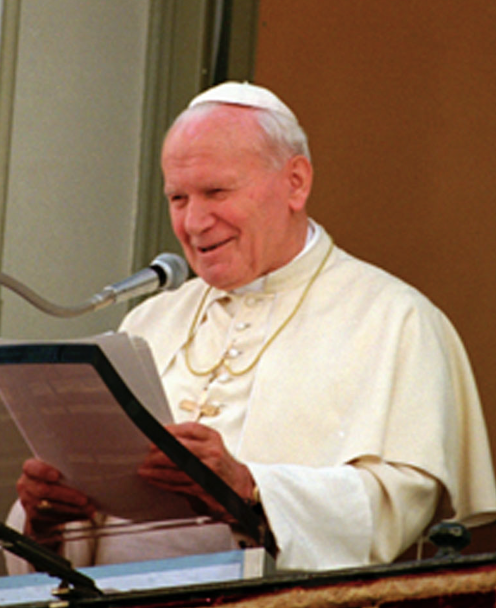
Pope St. John Paul II
Anne and John Duddington