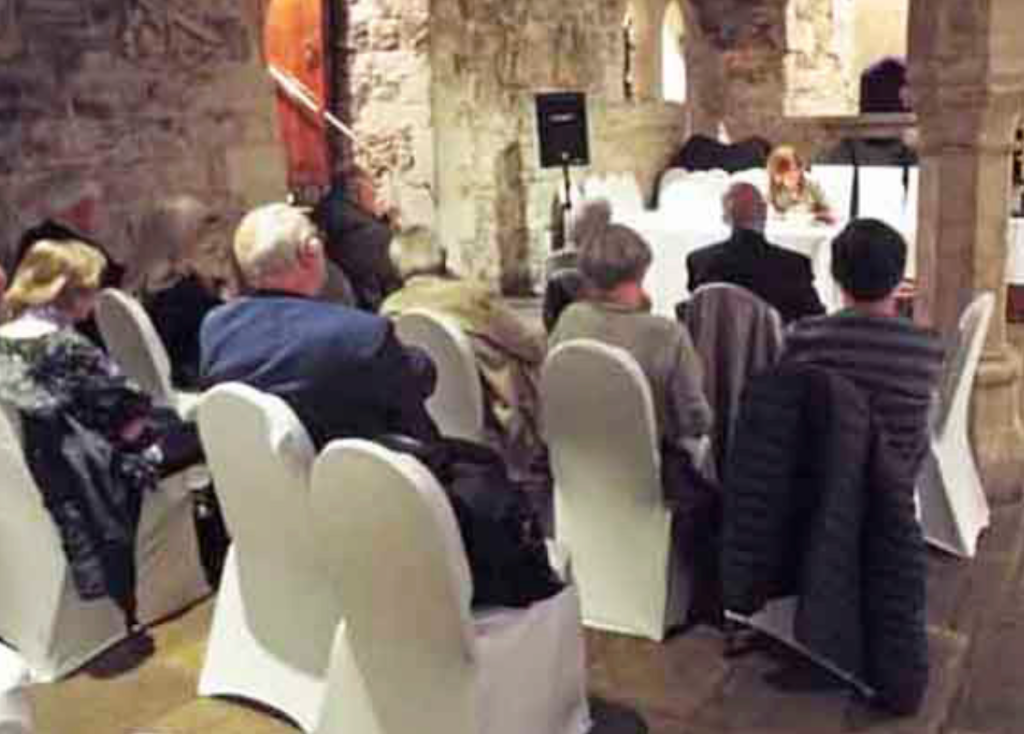
A shortened version of a talk delivered in the Crypt of St Etheldreda's Church, Holborn — London Newman Lecture, May 9th, 2019.
London Newman Lecture – May 9th, 2019
This is a shortened version of a talk delivered in the Crypt of St Etheldreda's Church, Holborn
It's always a pleasure to engage with Newman. There is the fineness of his mind and the beauty of the prose and the independence of thought, but also the crabbiness and the crossness and the humanity: it all adds up to a very complete human being. He does say to one of his correspondents: "I am not a saint, saints do not tell or write tales".
He spanned the Victorian age, and that was the age of great letter-writers. Newman's life was in his letters – and they run to 32 volumes. His famous contemporaries all wrote incessantly to many correspondents. Newman was not a diarist, but in effect the letters take the form of a diary. The title of this talk is Newman's Letters to Women, a theme which was suggested to me by Eamonn Duffy, the church historian, because in crossing the gender divide he speaks in a way that is more unreserved than to other correspondents. He speaks more freely to women than, on the whole, he does to men. There was something about the character of his female correspondents that rendered him at ease with them.
We should look at his family. His mother was a very charming lady and he had five siblings, three brothers and two sisters, and it was absolutely evident that he was far closer to his two sisters. The sisters were Mary, Jemima and Harriet and of those three Harriet was a feisty sort of character and the freest to speak her mind. Jemima was the most constant correspondent, right until the end, and he wrote to her freely and reflectively. He wrote to Jemima almost as though he wrote to himself in a diary. Mary, however, died when she was very young.
Good-quality paper
He didn't speak down to his sisters at all, or indeed to any of his female correspondents. He commended to his future biographer sections of his letters to his mother and his sister as being a primary source of his life. He advised his sisters on the need to use good-quality paper because he was very alive to the value of his letters as an insight into his thinking at any time, and almost as the equivalent of a tape recorder, as a record of his thinking on any particular subject at any particular time.
Controversy engaged him for his entire life, and he was very conscious of having exact copies of a letter and copies of the correspondence from that time, so as to be able to refute any allegations that were made about any controversy after the event. So we can think of these letters as partly the contemporary equivalent of a tape recorder. We will come to other female correspondents later, but I just want to sound a warning at the outset about what these letters don't contain: they don't contain anything of any real bearing on any of the great issues of the time.
We have here a man who was extraordinarily prominent in his day, terrifically influential on the critical issues facing the Church, and yet who took next to no interest in conventional politics or letters. We have a letter at the outset which is addressed to his sister, who was 14 at the time, in 1815. "My Dear Jemima, it is always a great pleasure for me to write to you, for the following reason. If I write to Harriet she always replies with a letter which is by no means suited to the dignity of my character but you, Jemima, always like a serious, sedate, sensible epistle." He thought she was a kindred spirit, sedate and sensible rather than flighty like Harriet. But she and Mary shared his thoughts and affections and at one point he wrote to Harriet: "I cannot say how I love you. No calamity, I believe, could occur to me here so great as for me to lose your love and confidence. Of all my brothers and sisters you alone know my feelings and respond to them."

But his conversion to Catholicism greatly tested his relationship. Harriet and he effectively ceased their communication for nine years before her death. She did not hold back in her views of his conversion. And it is perhaps because she loved him, and he loved her so much, that the falling-out between them was so very bitter. It is for those who are closest that an estrangement can cut most deeply. When it came to Jemima she too got the brunt of his feelings, and his rudeness, at the time of his conversion. Even Jemima, the closest of the siblings, wounded him; in his seventies he wrote a furious letter about her reluctance to allow him near her family.
Writing to Jemima
But his letters to Jemima were reflexive and poured out of him as they might to a diary – on one occasion he told her he had a headache and could not study so was giving himself the pleasure of writing to her. When she told of her engagement to John Mozley he found it a loss: "A brother never had a greater loss, nor another a greater gain. I have been thinking, praying and dreaming of you ever since".
He was never able to show his feelings to his mother and his sisters. But his mother and his aunt Betsy were dear to him; his letters to them showed him at his best, kindly and solicitous. To his mother he wrote: I believe my first wish on earth is for your happiness and comfort, my dear Mother, though I do not show it near so much as I ought and desire. He tried to keep the controversy over his conversion from his aunt.
He wrote of revisiting their childhood home: "Whatever good there is in me I owe under grace to the time I spent in that house and to you and my dear grandmother, its inhabitants. I do not forget her bibles and the prints in it. Alas my dear Aunt, I am but a sorry bargain, and perhaps if you knew all about me you would hardly think me worth claiming."
He shared all his hopes and reflections with his mother: when he and his party ousted Robert Peel from Parliament (he was too keen on Catholic Emancipation) he shared his thoughts on victory with her. He wrote a fine description to his mother of his first impression of the Pope on his visit to Rome. In his correspondence you can see the material for his sermon as an Anglican, on the love of relations and friends, in which has in his sights those "who love their fellow man and hate their nextdoor neighbour" or rather those who are "morose and cruel in their private relations but who profess a love of humankind." We get to read some of the girls' letters back and you could say that the spirit of Jane Austen inhabited them ("Miss Austen has no romance, none at all: what vile creatures her parsons are!") Poor Newman attempted to help find them husbands, which misfired in the case of Jemima and Robert Wilberforce, son of the campaigner William.
He had a number of female friends including the impossible and beautiful Maria Giberne with whom his brother Frank had fallen in love. As Sister Maria Pia she featured in his correspondence until her death and she proved invaluable during the Achilli trial*. Then there were the wives of his friends such as Mrs Mary Wilberforce, and Elizabeth Bowden, who married his friend John Bowden; there was, too, Catherine Froude, sister-in-law of his great friend Hurrell Froud. Some of those letters were written to them when they were bereaved, suggesting a real appreciation of the value of marriage. In the case of Mary Wilberforce he shared the agonies over his being received into the Catholic Church. "Time alone can turn a view into a conviction….the greater the sacrifice, the more cogent the testimony."
He advised a number of female converts, characteristically advising them to think for some time about what they were doing. For Anglicans three or even seven years was the period he seems to have considered necessary for reflection – but, when convinced, they should act. To Mary Holmes he advised: "To any friend who asked me what to do I should prescribe three years. It is a comfort in matters of religion to follow, not to originate: do not rush forward, but follow".
In fact it was to Mary Holmes that he wrote: "I made things worse by being rude when I wished to show my sympathy. As for myself, you are not the only person to be disappointed in me. Romantic people always will be. I am, in all my ways of going on, A VERY ORDINARY PERSON."
St Catherine succeeded
He never patronised women; indeed, at one point he wrote to Emily Bowles, who talked to him about what she would do for him if she were a man by responding, that he should ask rather what she would do if she were a woman "for it was St Catherine (of Siena) who advised a Pope and succeeded – but St Thomas of Canterbury and St Edmund tried and failed." He was never quite as horrid in his letters to women as to men, but he revealed himself to Elizabeth Bowles on his doubts about Rome or about Manning in a way he had not done to anyone else. To Charlotte Wood he wrote about his antagonism towards Manning in respect of Oxford, concluding: "Now I have taken a great liberty with you. For I never wrote thus plainly and fully to any person yet." And his letters were theological and serious; his exposition of Faith and Reason articulated general principles exactly as he would have done for a man.
To the end of his life he wrote with a quill pen. He would often tell his correspondents that "I can't write because my hand hurts". The physical effort of writing for hours and hours at a stretch was such that he couldn't hold the pen, and it is a minor miracle that he didn't end up with what we call repetitive strain injury.
As I say, he never patronised women as correspondents in religious matters and he wrote confidentially to women in a way in which he simply didn't do to men. He wrote a letter to Elizabeth Bowles on his doubts about the character of Rome, in that the debate within the Church was no longer what it had been in the Middle Ages. He said that the letter was most private and he hadn't ever written to anybody in this way before. He discussed a controversy with Manning over whether Catholic young men should be allowed, or encouraged, to attend Oxford. Newman's view was that rather than set up a Catholic college there should be a rectory house or a Jesuit house specifically designed to give support to young men who were surrounded by unbelievers – at that time when there was a lot of agnosticism at Oxford. It is interesting that he never wrote to a man about this highly sensitive subject, yet he wrote to Charlotte Wood about it. He also wrote about one of his expositions on Faith and Reason to Charlotte Wood, and also discussed the excessive level of control by the Vatican.
"It is not good for a Pope to live twenty years," he wrote, "because he becomes a God and there is no-one to contradict him. He has no new facts and does cruel things without meaning it." In other words, he wrote to this lady in a way that would have been exceptionally dicey if he had written it to anybody else. It could have been his undoing. But to at least three women he wrote confidentially about controversies that could have got him into great difficulties. He trusted them, and wrote to them most fully.
At the end of a very long life it is quite moving that one of his letters was to Grace, who was Harriet's daughter. She came back from Australia and came to see him and he was terrifically kind to her. His letters came full circle: he had started out with the most intimate letters to his mother and his sisters and he ended with an affectionate letter to Grace and then a meeting with her in which he held her hand throughout.
Newman's letters to women, I think, are particularly illuminating about his character. They show, I think, a little more vulnerability, and a respect for their intelligence, their courage as converts being quite equal to that of any of his close male friends. So, without trying to suggest for an instant that Newman was a feminist I think we can say from his correspondence that he was a friend of women.
Melanie McDonagh is a columnist for The Tablet and a leader writer for the London Evening Standard.
*In 1851 Newman was successfully sued for libel by Giacinto Achilli, an Italian ex-Dominican who was a notorious sexual predator and had fled from Italy to England.