A talk given to the Coventry Newman Circle in February 2015, exploring what Catholic Evangelism means and why sharing the good news of God's love is at the heart of every Christian's calling.
Once upon a time – a good twenty years ago – I was a Lay Minister in a group of parishes in the North Cotswolds. It was quite an exciting time for me. The woman vicar of our parishes had just been ordained priest and I was beginning to wonder whether it was in any way possible that God might be suggesting something similar to me. We were training a new Local Ministry Team to help with leading worship and the training had drawn a delightful group of people together who were unfailingly kind to me as a young mum, several decades their junior. But they were also prepared to be honest about their own vulnerabilities and the things that they just didn't know.
It was one of them, Sheila, who first made me think about my own attitude to evangelisation – or evangelism, as the Church of England puts it. We had completed modules on Old and New Testaments, on Pastoral Visiting and on the preparation of family-friendly non-Eucharistic worship. We enjoyed our evenings exploring together, sitting around a kitchen table. But when we realised that the module next on the list was 'Mission and Evangelism' there was, suddenly, an uncomfortable chill in the air. That group, who had been so relaxed in one another's company, suddenly started looking at their papers or staring out the window – doing anything rather than engage. Finally Sheila burst out: "It's no good. If I have to do evangelism to be an effective Christian – well, I'm giving up!"
I wonder if that's you?
- Whether evangelisation feels like a duty or a joy?
- Where you place yourself on the spectrum when it comes to sharing the joy of the gospel with others...
- Whether you are overwhelmed with zeal, or secretly hoping that the whole thing will turn out to be something that really only applies to other people?
You might like to think about that.
It's funny, isn't it – the way the 'E' word terrifies so many of us. I guess it's hard to dissociate it from Bible bashing hardline preachers, or the lone crank with the sandwich board at Oxford Circus, in other words the kind of zealots that give zeal a bad name. We know that we should be overwhelmed with enthusiasm at the idea of sharing our faith with others, but somehow those images intervene and we leap back, convinced that evangelisation is just not for us.
Or is that a purely Anglican problem? Perhaps it is...I certainly can't imagine that a work by the ABC entitled The Joy of Evangelisation would provoke much genuine enthusiasm; but, nonetheless, the past decade has seen the Church of England engage with evangelism with fresh enthusiasm. This is an enthusiasm that springs largely, I think, from a renewed understanding that it is not the Church of God which has a mission, but the God of mission who has a Church. In other words, the mission imperative comes not from the Will of the Church, but from the character of God. The Father sends the Son who sends the Spirit. And that the three together send the Church.
Missio dei
Since God is constantly reaching out to us in love, through each and every aspect of creation, since he is so passionately intent on communicating that love to us that he chose to enter our world as Jesus, do we actually have any option at all? John Chrysostum said "I cannot believe in the salvation of anyone who does not long for the salvation of his neighbour" – because, after all, once we know ourselves fully accepted, welcomed and transformed by a loving God, the only possible human response must be to share that experience of loving welcome with others.
I'm from that end of the C of E spectrum which is proud to describe itself as 'catholic' in theology and praxis – valuing a strongly sacramental ministry, keeping the Saints and focussing on the centrality of the Eucharist. But I would say that 'Catholic Evangelism' is a call for the whole church – because, of course, of the true meaning of catholic is ALL EMBRACING, and the point of the Gospel is always, always, to share it. It is our calling to play pass-the-parcel with the good news of God's love so that everyone can know and respond.
In 'Evangelium Gaudii' Pope Francis writes "Evangelisation is the task of the Church, first and foremost a pilgrim people advancing towards God"…It is never something that can be left to others – the ordained, those with a special gifting or inclination. "I am a mission on this earth; that is the reason why I am here in this world" he says – and "I" in this case means not Francis, not Justin, not a select and holy few – but every single one of God's people – here to live out God's loving purpose and to share it with others. In other words we are dealing with evangelism for all – both those who give and those who receive!
These days evangelism is often thought of as something Protestants do (indeed, in the C of E 'evangelical' and 'protestant' are almost interchangeable as descriptions of a particular kind of churchmanship). But that hasn't always been the case; go back, for example, to the 16th Century when Protestant Christians were almost entirely inwardly focussed on coming to terms with their new 'Reformed' identity and it was Catholic missionaries in the form of the Jesuits who went off to far off lands such as India, China, the Philippines and Japan to tell people about Jesus's love for them.
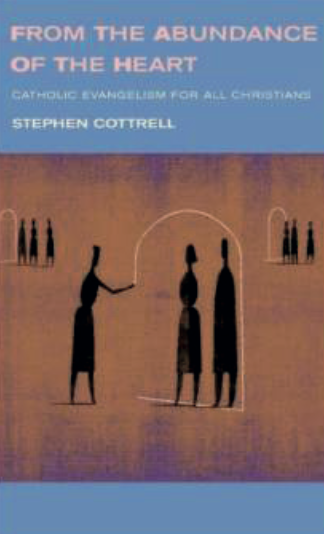
Of course we may still have anxieties about the 'E' word but listen to this wisdom from Bishop Stephen Cottrell, writing in his splendid book From the Abundance of the Heart – Catholic Evangelism for all1. "Although many people in the church today are still suspicious about evangelism, the sharing of good news is something we do all the time. If we have experienced something as good and joyful, there is nothing more natural than to share it with others. So, if we go to a good film, read a good book, if our football team wins, or if a new child is born into our family, we tell people about it. We don't feel we are oppressing them in any way by telling them about it. We don't necessarily expect, and we certainly don't demand, that they see the film, read the book, support the team or adopt the baby! We are not looking for any reward. We simply share our excitement with them. We have experienced something to be good. We tell people about it. We can do no other."
Put like that it sounds so simple! Who WOULDN'T share good news of a birth?
The difficulty comes if we haven't experienced our faith as such good news...
Pope Francis recognises this problem: "Unless we are convinced from personal experience that it is not the same thing to have known Jesus as not to have known him, not the same thing to walk with him as to walk blindly, not the same thing to hear his word as not to know it…" – well, our evangelism is never going to be very fruitful – and in any case, why would you even bother?
If all we have to offer is membership of a worldwide club with some slightly unusual membership requirements and practices – then the whole enterprise is unutterably pointless. Deeply conscious of our roots in history, recognising and treasuring the legacy of the past, we don't necessarily embrace change with much enthusiasm – and there's also a natural human tendency when under threat to cling to what we do know and trust that can make it particularly tricky to recognise when some changes are not only desirable but essential.
That never means throwing out the baby with the bathwater – but it does mean being conscious of the changing shape of modern life. While Sunday was most definitely a day when not a lot happened in my childhood, by the time my own children came along most of their friends were doing exciting things on Sunday mornings. With both parents working full time and Saturday as catch-up day, Sunday is often the only real family time – and unless the church becomes better at modelling family – including everyone, ensuring that there is space for them to be themselves with one another and with God – we may well find ourselves rejected by those who with whom we already have a connection. The chances of bringing others to share the good news are frankly remote.
In any case, it's not really all about what happens within the Church, is it? One of the great catholic evangelists of the last century, Vincent Donovan, of whom more later, wrote: "' It is amazing how, in every crisis in world history, the church has the temptation to react in an inturned way. "Straighten out the calendar of the saints", it says, "or purge some of the more outlandish ones on the list. Reform Canon Law. Revise the seminary curriculum or structure. Make new laws about the priesthood or the religious life. Clean up the liturgy. Tidy up the sacraments. Be good and the world will come to you."
That's the sort of behaviour that earns us a reputation as experts in rearranging the deckchairs on a certain doomed liner. And, try as we might to render our liturgy more enticing, our worship times more convenient, people won't come unless they have good reason to do so. And the trouble is, of course, that so often what we do and who we are is so very loud that nobody can hear, even for a moment, what we say! So – before the Church can engage with evangelising the world she needs to receive the good news for herself and be transformed afresh by the gospel.
Stephen Cottrell again: "Do we experience the Christian faith as good news? Are we in a place of receiving, where the goodness of what God reveals to us in Christ can actually start shaping and changing our lives?" Or if you prefer Pope Francis: "We know well that with Jesus Christ life becomes richer and that with him it is easier to find meaning in everything. THIS IS WHY WE EVANGELISE!"
As an unashamed liberal, who believes that hell is empty because the goodness of God is always greater than the worst of our human sin, I find that last explanation really helpful. We are not evangelising in order to offer people a sneaky "Get Out of Jail Free" card but rather because, to repeat: "We know well that with Jesus Christ life becomes richer and that with him it is easier to find meaning in everything. THIS IS WHY WE EVANGELISE!"
Isn't that wonderful!
The best reason
Over the past decade the C of E has introduced something called 'Back to Church Sunday' - and provided all sorts of exciting resources from tailor-made invitations to specially designed Fair Trade tee shirts to support the campaign. But I'm sure I'm not alone in having worshipped in some churches where my prayer would be not "Dear Lord, please send more people to meet you in this place" but rather "Dear Lord, PLEASE send anyone who is seriously seeking you somewhere else...if they come here they'll lose all heart and hope instantly"

So we need to be confident that we are inviting people into a church that lives and breathes the reality of their life in Christ. Put another way, before the Church can evangelise the world, the Gospel must evangelise the Church. Some churches will work really hard on 'outreach' to particular groups – very often young families. That's brilliant – if the church is thoroughly committed to the flourishing of the whole community.
But too often, whatever the intention, what actually happens is something like this. A Church Council meets and has a long, hard, look at itself. The conversation unfolds along disturbingly familiar lines.
- If we don't regenerate, everyone will eventually get old and die.
- It's energising to have young people around.
- Younger members can do the work that older members can't manage anymore.
- Young families remind us of church when we were younger, and our children not yet grown up and gone
What price now loving service? Suddenly instead of an invitation issued in response to God's overwhelming love and grace poured out for us, we have what amounts to a marketing campaign, manipulating people as targets who can be used for our purposes. At this point we are dangerously close to saying that we want these rare and valuable Young Families for what they can give to us rather than celebrating the fact that, as Pope Francis put it: "Every person is immensely holy and deserves our love".
To use that as our foundation is to revolutionise our approach to evangelism. Suddenly, rather than wondering whether we can persuade the playgroup families who meet in our Hall to cross the Church threshold and come to Mass, we are able to ask with honesty what do those families need? How can I show them by the way I care for them that they are uniquely loved and precious to God? How can I serve these people, in this place – the community that God has given me here and now, the community God has given me to love?
So let's try that Church Council scenario again, with a different agenda. Suppose that the Church was above all determined to feed souls and share authentic community? By that light, young families are welcome! Of course they are. So are older families, childless couples, singletons: so welcome, so very, very welcome. And most welcome of all must surely be the broken people, those who are unlikely to contribute anything except their wounds and their neediness; those who will never make it on to the readers' rota nor help with a successful fundraising push; the broken.
Now that would be a church worth belonging to...and if the good news that we are sharing is good news for the broken, then all is well. Pope Francis declared: "The heart of the Christian moral message is love for one another, which must motivate Christians to share the Gospel, help the poor and work for social justice."
Bishop Cottrell again: "And here we come to the first of many paradoxes that inevitably shape any consideration of Christian faith. It is in giving that we receive. We may not get very far in enabling the gospel to evangelise the Church if we do it in a vacuum, locked away inside Church buildings and Church culture. It might best be done in the community around us. After all, the raison d'être of the Church is the needs of the world."
Evangelism is indeed about looking outwards – but it's about doing so without being in any way predatory. Despite the reminder that the fields are indeed white for harvest, it's not about harvesting souls for the sake of filling barns and shutting the doors firmly against the world. Indeed, woe betide anyone who believes, even for an instant, that the Church has the monopoly on God's actions in the world he loves so much. As then Archbishop Rowan Williams wrote in his foreword to the C of E report of 2004, 'Mission Shaped Church': "Mission is about working out what God is doing, and then joining in", or if you prefer Pope Francis' version "Look for the people, places and trends where God is present".
We're catholic, after all, and for me part of that is recognising that God made the whole earth to be a sacramental sign of His presence – so that we can constantly expect to find him in all his creatures, and, finding Him, point out his presence to others. For me, that is very close to the heart of evangelism; saying to friends and strangers: "Look! This is Holy ground! YOU are Holy ground. Here God lives among God's people."
Remember that St Dominic felt called to found his missionary order after spending the whole night in a Tavern chatting about faith with an innkeeper who was a Cathar. Part of the reasons Catharism was so prevalent at the time was because the official representatives of Christianity in the area, the Papal Legates, lived a life of luxury, so remote from most ordinary people that they even travelled shielded from their gaze, as they were carried around on litters. It was no surprise that the Southern French peasants could not relate to this and willingly threw in their lot with the heretics.)
So Dominic established an order of poor priests to live among the people rather than above the people. In the same way, Jesuit missionaries to China in the 16th/17th century dressed as Chinese philosophers – so that they would underline respect for the local culture rather than standing outside it as critical foreigners, intent on imposing an alien culture. This approach reaches its apotheosis in the work of Vincent J Donovan, which formed much of the thinking behind 'Mission Shaped Church'. In Christianity Rediscovered2 he tells of his own faltering attempts as a missionary to the Masai, transformed when he began to understand that the only way he would ever get the gospel across would be if he could translate it into the CULTURE, and not simply the language, of those he was trying to reach.
"As I began to ponder the evangelization of the Masai I had to realise that God enables a people, any people, to reach salvation through their culture and tribal, racial customs and traditions. In this realization would have to rest my whole approach to the evangelisation of the Masai."
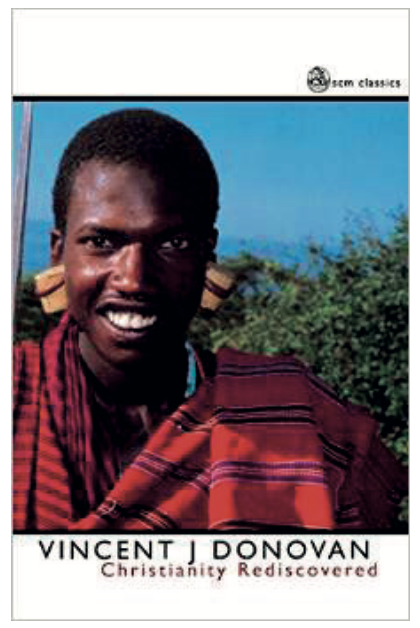
It worked! Of course it did, because after a year of sharing the Gospel expressed in Masai terms Donovan helped them to recognise the God already at work among them. He had the courage to recognise his need to listen and learn, rather than proceed from a position of superiority..."Jesus is the answer. Now tell me the question." Jettisoning accepted missionary practice must have felt dangerous to the point of lunacy - but then the heart of the Gospel is surely holy lunacy – a baby in a manger, a man dying on a cross. His lunatic courage bore fruit. Stripped of its western cultural accretions the Gospel made sense and as he immersed himself in the ways of the Masai they understood that he was truly committed to their communities.
The Masai Creed
It was a breakthrough for Donovan when one Masai village forged its own creed: "We believe in the one High God, who out of love created the beautiful world and everything good in it. He created man and wanted man to be happy in the world. God loves the world and every nation and tribe on the earth. We have known this High God in the darkness, and now we know him in the light. God promised in the book of his word, the bible, that he would save the world and all the nations and tribes.
We believe that God made good his promise by sending his son, Jesus Christ, a man in the flesh, a Jew by tribe, born poor in a little village, who left his home and was always on safari doing good, curing people by the power of God, teaching about God and man, showing that the meaning of religion is love. He was rejected by his people, tortured and nailed hands and feet to a cross, and died. He lay buried in the grave, but the hyenas did not touch him, and on the third day, he rose from the grave. He ascended to the skies. He is the Lord.
We believe that all our sins are forgiven through him. All who have faith in him must be sorry for their sins, be baptized in the Holy Spirit of God, live the rules of love and share the bread together in love, to announce the good news to others until Jesus comes again. We are waiting for him. He is alive. He lives. This we believe. Amen."
This process of enculturation has been foundational in our understanding of mission and evangelism over the past few years – and as a result things like cafe church, skaters' church and church in the pub have emerged...communities gathering around the person of the Risen Christ, exploring the meaning of faith and discipleship together and, as they become a community, learning to value and to celebrate the sacraments too. This isn't 'either/or' - but 'both/and', or what Rowan Williams dubbed the 'Mixed economy church', enabling evangelisation in terms that everyone can own.
But we know, of course, that you can't be a Christian alone. Evangelism isn't just about bringing people into relationship with Jesus, it's about bringing people into relationship with his family the Church. For catholic Christians, being Christian is about being part of a community, that band of pilgrims travelling together as sisters and brothers. This is both appealing and alien to many in this age of individualism: while people are willing to admit to loneliness, they are loathe to give up self-determination and the impact of community life lived well (life shaped by the catholic disciplines of spiritual formation- self-examination, confession – is both attractive and abhorrent).
And of course the point of the Church as community is that it can never be a sanctuary of like-minded souls. It is all about pushing us beyond our comfort zone – because that is what God does. He is always ahead of us, already talking to those awkward people we hoped we wouldn't have to meet. What can we do but follow? Again we find ourselves recognising truths discovered by Vincent Donovan, who wrote to his fellow missionaries – to all of us who long to be catholic evangelists: "Do not try to call them back to where they were, and do not try to call them to where you are, as beautiful as that place might seem to you. You must have the courage to go with them to a place that neither you nor they have ever been before." God is on the move, and we are invited to travel with him.
Of course, as catholic Christians (Anglo- or Roman-) we will have particular nuances and emphases relating to how we think about evangelism. We might be more reticent about altar calls and conversion experiences (for surely we know that conversion is a continuing process, involving failure, repentence, and a new start again and again and again). For all the dramatic conversions à la Saul or Francis there are many other slow growths in faith and understanding.
But the most famous modern example today of a process-led (rather than decision point) method of evangelism actually comes from charismatic evangelicals - the Alpha Course. That doesn't mean we catholic Christians would necessarily give exactly the same talks on the Alpha Course (though of course there is the Catholic version) but the method chimes with our own understanding of how we can grow into our knowledge of the good news of God's love.
For at the end of the day we are left confronting the simple truth that actions speak louder than words. The instinctive catholic model of mission is both incarnational and sacramental...combining worship and service. At the altar, actions speak louder than words; they do so on the streets as well – and it is the same Christ who is worshipped and adored in sacrament and slum. We continue his mission as we are baptized into his Body, and we live his life, for others, in the World he loves so much.
This talk was given to the Coventry Circle in February 2015. Canon Kathryn Fleming is Canon Pastor at Coventry Cathedral.
1 Published by Darton, Longman & Todd (2006), £12.99
2 SCM Classics (2001), £16.99