A review of Tess Livingstone's 2002 biography of Cardinal George Pell, exploring the contrasting conceptions of Roman Catholicism his life and career reveal.
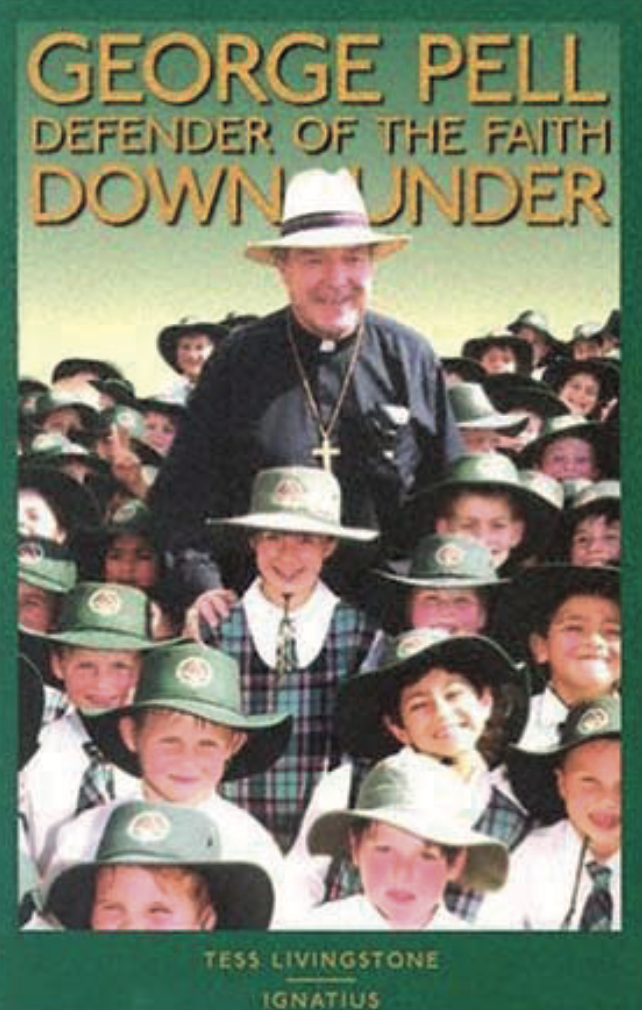
The 2002 biography by Tess Livingstone* has been a revelation to this reader of what different conceptions people may have of the Roman Catholicism. For George Pell, the distinguished Australian churchman, now a cardinal, the Church is an authoritative institution founded by God, infallible in all it teaches. No development of doctrine is envisaged, and he would appear to understand the Church as the Hierarchy rather than as the People of God.
Therefore the principle of conciliarity – the collaboration of bishops – is right and proper, but that of subsidiarity – decisions to be taken at the lowest relevant level – totally unacceptable. His meteoric rise to the height of governance shows how his thinking is in accord with that of recent popes. Last year he was appointed head of the Vatican's new Secretariat for the Economy, with a brief to clean up the finances of the Roman Church.
His biographer is an admirer; and it is fitting that people's lives should be written by those who appreciate all the good in them, so long as they do not omit any flaws, and there is a lot to admire in George Pell. From his schooldays he stood out as someone of integrity, courage and strength – patently a leader of men. He has a very warm relationship with, and is much loved by family members; his little niece could knock on the presbytery door and be invited to take tea with uncle "Georgie". He is courteous in debate, never reviles his opponents and his very real compassion is shown in his private call on a bereaved couple to bless their dead baby and in his unsung visits to AIDS sufferers.
A vigorous style
But his vigorous football-playing style, expecting to give and receive injury, is an indication of the way he governs, which has earned him many implacable enemies. A firm supporter of Vatican II, but aghast at some people's woolly version of the "Spirit of the Council", he is considered by some conservatives as not conservative enough, while some LGBT members actually chant "George Pell, go to Hell!" (hardly Christian, however great the provocation).
His reforms of Corpus Christi seminary were very badly received; in 1985, when he was rector, his "few small changes" were imposed without consultation and many students left in dismay; in 1996, as archbishop, it was the teaching staff who resigned. George Pell's vision of training for the priesthood prioritised the seminarians' relationship with God, through daily attendance at a fixed early mass and obligatory devotions to the Virgin Mary and the Blessed Sacrament. Others might see as equally important the freedom to develop their own unregimented prayer life and, above all, to develop a deep love for the people they were to serve, and not to impose church teaching regarding their private lives with no empathy for their lived experience.
His reaction to the clerical sexual abuse scandal, calling it "the worst blow to our prestige" seems to prioritise the institution above the welfare of children, and he declared that abortion was a greater sin because it destroys a human life. However he made strenuous efforts to deal with clerical sexual abuse, setting up the (eventually nationwide) organisation Towards Healing. On refusing communion to wearers of the rainbow sash (including, as it happened, the mother of a gay son) he explained that he did not condemn anyone but he could not ignore this open manifestation of disobedience to Church teaching. Inevitably such a stance attracted virulent accusations of homophobia.
Far worse was an anonymous accusation in 2002 that Pell, as a seminarian, had abused a 14-year-old at a boys' camp. Pell immediately and honourably stood down until cleared by the court, but it was an appalling blow. More recently an accusation has resurfaced that, when a man reported to him that his uncle, a priest, had abused him, Pell had asked "What will it take to keep you quiet?" offering him money and a car. The trouble is that, despite Pell's well-attested integrity, such an accusation is feasible with regard to someone with such an overwhelming loyalty to the institutional church, and he has many enemies out to get him.
Some particular actions of his have grieved liberal Catholics: banning a book questioning the teaching of the Church, banning the Third Rite of General Confession and Absolution and denigrating the inclusive language of ICEL translations. He also called for a celebration of Humanae Vitae 30 and welcomed Opus Dei into the diocese. Pell also declared that Jesus would punish those who sinned against his teaching on marriage.
But this is a man who faithfully served the Church all his life according to his lights and achieved great things. He worked for Caritas and recorded the terrible sufferings he saw in different continents; he was a member of the CDF for 10 years; he ran two major archdioceses, Melbourne then Sydney; he reformed the Catholic education of children, writing two textbooks. In addition he regularly heard confessions in the cathedral to keep in touch with his people and made himself available one afternoon a week for priests to come and see him informally. But for this reader the best indication of his worth is the sermon he preached to 20,000 sixteen- and seventeen-year-olds in 2000. Picking up on the then recent film Gladiator, he described how the early Christians' loving community stood out against the barbarity of Roman Society and he inspired these young people to follow their example in today's troubled world.
I do not see eye-to-eye with the Cardinal on many counts but I cannot fail to admire the man.
Josephine Way
*George Pell: Defender of the Faith Down Under, by Tess Livingstone; Ignatius Press; out of print, but available secondhand (paperback) for £5.99 on Amazon