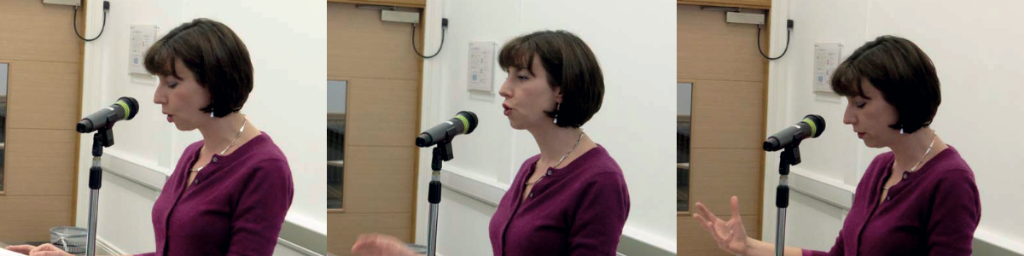
The inaugural Manchester Newman Lecture 2015, exploring what Catholic Social Teaching's concept of the common good has to offer to electoral politics, by Dr Anna Rowlands of Durham University.
The Manchester Newman Lecture 2015
These are the words of Michael Sandel, the popular American political philosopher, writing in The Guardian in 2012:
"We can't decide any of the questions we argue about without implicitly relying on certain ethical ideas, certain ideas of justice, certain ideas of the common good. We can't be neutral on those questions even if we pretend to be."1

The idea of the common good is back on the political and economic agenda. Public intellectuals including the socialist-anarchist thinker Noam Chomsky and the communitarian thinker Sandel write in support of the idea that we need to retrieve the concept of the common good. For Sandel our biggest challenge is to find intellectual and practical resources that help push back against the pervasiveness of markets in determining our human experience. Sandel calls for a critique of the idea that economic efficiency, "defined as getting goods to those with the greatest willingness and ability to pay for them", determines what we commonly understand by the common good2. For Chomsky we have reduced the notion of the common good to little more than an aggressive focus on private gain alone. This dominant cultural emphasis suppresses the deeper social emotions of solidarity, mutual support and care, which are vital to our social wellbeing and tend in practice to motivate much of our actual behaviour.
But whilst Sandel and Chomsky might largely agree on what is wrong with the way we currently think about politics and 'common goods', they do not agree on what should replace our current approach. Sandel, in particular, has drawn attention for his willingness to defend the role that religion can play in fostering a less primarily market-driven version of the common good; but others still feel that religious traditions are conversely too divisive and too idealistic to foster a genuine common good.
Despite this continued liberal concern about the role that religion might play in forging a common life, one of the most significant contributions to the re-emerging contemporary conversation about the common good – its meaning, significance and substance – has come from Catholic social teaching (CST). Indeed CST's version of the common good has been a key resource for the 'Blue Labour' and 'Red Tory' movements. Jon Cruddas, author of Labour's Policy Review, has repeatedly stated that he wanted Labour's manifesto for the 2015 election to be based on CST and its concept of the common good. Even the Greens – not known for their orientation towards such language – launched their manifesto with a common good tagline.
Along with the concept of human dignity the principle of the common good is a foundational one in CST. It is an idea that has its roots in Aristotle, and was developed most coherently in its Christian form by Thomas Aquinas. However, despite these deep roots, it can be a notoriously slippery term, sliding easily through the fingers, or else being open to serious manipulation at the hands of those who want to use it to their own advantage. In the process the term becomes either vacuous or dangerous, emptied of its richer meaning and content.
The meaning of the Common Good
So what does CST say about the meaning of the common good? The Second Vatican Council defined the common good as: "The sum total of social conditions which allow people, either as groups or as individuals, to reach their fulfilment more fully and more easily"3. Later Church documents have referred to the common good not so much as a process of social life but more as the end or telos of social life itself – the goal of living in society is to attain the common good. We still find both of these emphases in CST.
In a recent article the Anglican evangelical theologian Oliver O'Donovan slightly rephrased this understanding: "The common good is the good of the community of communicating members, consisting in their capacity to realise fulfilment through living together"4. Similarly, the British Catholic philosopher John Haldane has tried to break open the idea of a good which is genuinely 'common' by distinguishing between five different kinds of goods. In ordinary conversation there is a tendency to use the term 'common good' as an umbrella term to cover what might actually be better understood as a series of quite different, although interrelated, goods. By way of illustration we often tend to think about the provision of public services as matters of the common good. In a sense they are, but Haldane argues that in fact some of these kinds of goods are better conceived of as public goods: goods where the possession or enjoyment of them by one group does not preclude similar benefits being enjoyed by others.
By enjoying clean air I don't use up a quota of clean air that prevents others from having access to the same good. Haldane also distinguishes private goods, individual goods, and collective goods from common goods. Private goods involve the possession of a good by one party, such that another may not simultaneously possess it: an appointment with my hairdresser or doctor or dentist, for instance. An individual good is a good that attaches to an individual independently of the well-being enjoyed by others: warmth, the absence of pain. A collective good denotes a set of individual goods: aggregate wealth, property ownership. However, for Haldane, as for O'Donovan, truly common goods are goods that relate to the life of collectivities and can only be enjoyed through membership of groups. Truly common goods are always more than aggregates, more than collections of interests.
So what are Haldane and O'Donovan trying to emphasise? Both men are deliberately placing emphasis on the idea that because we live in communities we must be capable of communicating with each other in order to create the social conditions necessary for achieving something close to the common good. The common good does not boil down to the sum of interests, the aggregate of the things we individually lobby for. You cannot, for example, reach the common good from a vast focus group exercise, which surveys what groups of people think in order to deliver public policy on an (often short term) aggregate basis.
The focus group run by the pollster wants to know only about sums of interests. If we are going to focus on the necessary conditions for you and I to have a decent conversation about what we care about we need to think hard about the best ways for us to communicate with each other, most especially about the things that are tricky to talk about. The way we set the conversation up makes a difference to whether we can really talk about goods, or only about interests. And so it becomes clearer that dealing in the common good assumes that we have some ethical concept of community in the first place and some practices to go with it – that we have at the very least a sense of place and relationship with neighbours. Of course, without this we will still have politics but we will not reach a politics of the common good. CST is not looking to get rid of the idea or language of 'interests', or common interests, but wants to reframe how we think about interests, including self-interest. And electoral politics needs to be able to participate in that, or else it becomes nothing more than a game of power and the assertion of the will.
A Christian notion of the common good challenges the idea that freedom is best thought about only in negative terms as freedom from coercion. CST still wants to think also about freedom for creative association: what we might create in communities where communication about the good becomes possible. This contrasts with the basic insights of many of the founding fathers of political liberalism for whom any attempt to make talk about the good – the foundation of political life – will tend to induce its opposite: intensified conflict. For a certain strand of Hobbesian political liberalism, to replace talk about the good with the brokering of interests is the best hope we have for a decent and peaceful politics. The Catholic social tradition has repeatedly challenged this worldview. A language of interests rather than goods sets us in competitive relation, takes scarcity rather than abundance as the basis of its political and social mindset, and arguably proves too 'thin' a moral discourse to build genuine human relationship and strong community.
Three Reasons Why This Tradition Is Important Now
In the light of this rough outline of the understanding of the common good, I want to suggest three very basic contextual reasons why in the context of an election we especially need to engage with the common good. First, to seek the common good is to seek a way of speaking and acting that unites rather than divides. This does not mean that all conflict is avoided – a point to which I will return. However, the concept and practice of the common good does represent an indispensible language and practice of relationship.
Although a Catholic notion of the common good is rooted in the Scriptures, and in the teachings and writings of the early church fathers, it is with the work of Thomas Aquinas that the idea receives its most systematic development as a distinctively Christian idea. In his writings on the common good and political rule Aquinas suggests that, within creation, multiple forms of practical 'care' exist so that we may be guided towards the end already purchased for us by Christ.5 He notes that if we were destined only for an end that lies within ourselves then the care of the doctor, teacher, banker, or tutor would be sufficient for us to live the good life. However, in faith we are destined for an end outside of ourselves and therefore need a wider form of spiritual 'care' from our political leaders to guide us beyond ourselves to communion with God and with each other.
Aquinas argues that we see here an analogy between the care for the 'one' and the care for the 'whole' or the 'multitude'. If the highest good of the one person is to be found in seeking education, physical health and material goods to sustain life, then it follows that these are the goods that the virtuous ruler needs to seek and protect for society as a whole: health, knowledge, and wealth maximisation. But here, Aquinas says, Christian faith makes all the difference to our politics. The Christian believes the good life to consist of other, truer ends: to live well together in peace, rendering mutual assistance and in so doing learning to participate in something of the life of God. This requires a capacity for a future-oriented reading of moral relationships and neighbour love. My neighbour is not just the person with whom I find myself in proximity now, but also the person with whom I might be destined to share the life of communion in God eternally. As I can never be totally sure who my eternal neighbour might be, perhaps I should err on the side of treating all as my neighbour. In the developing Catholic sacramental tradition, my neighbour is also an altar where I meet God now. Christ is mysteriously present in each neighbour in ways I cannot fully grasp. This is a radically inclusive, future-oriented vision of neighbour love. And it changes the way we see our politics.
Some such fundamental notion of irreducibly common goods, which produce the experience of a good that is more than the sum of their parts, seems vital in contesting the atomistic and divisive social language that currently permeates our social spaces. Lest this sound overly esoteric, it is worth noting the extent to which we are currently surrounded by divisive social language. Much of the political language – used across parties – that has been shaping our public conversations about austerity has been highly divisive. In fact, it has seemed at times as if the notion of virtue itself required a willingness to speak in such divisive terms: the deserving versus undeserving poor, strivers versus skivers, illegal versus legal persons. This kind of language comes to dominate our public spaces and fails to recognise the irreducibly common goods that ground a peaceable social order and strikes me as the antithesis of a Thomist view of social life.
The second reason we need the language and practice of the common good is connected to the first: because a Christian conception of the common good maintains a focus on the whole which is greater than the sum of parts it continues to speak of human value rooted in an account of being, rather than merely human function. It therefore provides a necessary challenge to all forms of public and private action seeking to reduce the human body and human relations to functions and interests, to costs and benefits. Talking only of private and public goods is too weak an account, morally speaking, to prevent the instrumentalising of human life and the endless invention of new forms of exclusion and destruction. As Hannah Arendt noted so clearly the language of function and interest quickly gives way to practices of human superfluity: to the idea that some people are not essential, can be discarded, expelled or even exterminated.6
In contrast to the language of function and interest, forms of common good language (when handled well) contain humanising words that help us speak publicly not only of hope but of the unacceptable and difficult: suffering, failure, pain and tragedy. Communication about the good within meaningful communities will need to carry stories of pain, anxiety, and profound loss. This is a side of common good talk we don't hear so much about.
Common good talk provides the possibility of a response to difficulty and human suffering that is more than silence, suppression, distraction or consumption. It is this approach to politics that Pope Francis has exemplified on the public stage, particularly when addressing the challenges of global migration into Europe. His first question to Christians in the face of migrants drowning was: have you wept? We overcome the 'globalisation of indifference' through first choosing not to anaesthetise ourselves to social pain in the name of 'wellbeing'.
New forms of socialisation
The third reason we need to maintain an engagement with the language and practices of the common good concerns the paradoxical challenge of learning to live with a vision of life in communion, but in the context of a generation experiencing the challenges and opportunities of radical plurality. Whilst we rightly talk about isolation, the breakdown of human relations and hyper-individualism as challenges to the common good, this captures only one dimension of a more complex social story. Arguably, what we face is not a simple decline of socialisation – we are all less sociable - but the simultaneous eclipse of older forms of socialisation and rebirth of new forms of socialisation.
Catholic social teaching began to discuss this reality in its handling of the common good from the 1980s onwards. John Paul II described forms of increasingly intense social interdependence, which he carefully and very deliberately distinguished from forms of social solidarity.7 He argued that increased use of all forms of technology, rapidly intensifying forms of human migration, the increased experience of bureaucracy in everyday life are all social facts which speak of newly intensified forms of socialisation. However, such forms of interdependence and socialisation are not necessarily expressions of solidarity or civil communion. Each has the potential to be so, when rightly engaged. John Paul II argued that solidarity is the solid social practice and moral virtue that moves us from intensity of basic socialisation towards something richer: a community of caritas, justice and peace.
Echoing and deepening this analysis, David Hollenbach SJ, of Boston College, suggests that these forms of contemporary interdependence simultaneously shape and limit our engagement with the common good.8 Intensified plurality of this kind makes conceiving of the common good more difficult, yet our only real ethical possibility. Hollenbach raises a series of questions for advocates and critics of the common good alike. Without some shared sense of the Real and the Good, it seems increasingly difficult to address any of the really complex questions we face.
The challenges are varied and significant:
- the crises in political authority
- the challenges brought by human migration
- the fallout from the economic crisis
- intensified forms of global conflict and displacement
- ecological change
- and the future of social care
These require some kind of concept of the common good. The question, as Sandel suggests, is less whether, but which, concept of the common good we hold. However, Hollenbach poses a serious question for any keen enthusiast of common good thinking: given the evisceration of our common good practices and the layers of ethnic, religious and economic difference to be negotiated, can a commitment to the common good be revitalised without, at least in the short term, provoking a simultaneously increase in social conflict?
It seems clear that any robust account of the common good we seek to pursue in response to these stark challenges needs to be more open to handling paradox and conflict. Both John Paul II and Francis have suggested that an account of conflict needs to be brought within a Catholic social teaching of the common good. Whilst this is hinted at as a necessary development, it is not yet a sustained theological reflection.9 Perhaps the much-anticipated social encyclical on ecology will offer us more resources to think about conflict and the common good. For CST to act as a convincing resource for those navigating political life at the coal face it will be increasingly necessary to talk openly and clearly about how we handle the conflicts.
A further (not unrelated) point concerns the need to prize apart a Christian form of common good thinking from a narrower idea that equates the common good with a rational intellectual consensus or a search for cultural homogeneity. This is to recall that the Christian understanding of the truly good is rooted first and last in forms of communion rather than in agreement per se.
Alasdair MacIntyre, the Scottish philosopher, is surely right that we still lack spaces for handling the properly deliberative element of the common good – but given the more spacious and imaginative contours of the Thomist account of the common good, we need to talk about more than just the deliberative element. Christian reflection on the common good needs to serve genuinely plural Christian forms and practices of the common good, of communion and gift exchange. Perhaps one of the most profound examples of Christian common good thinking is to be found in the life of L'Arche communities established by Jean Vanier or the Focolare movement, through their creative business practice found in the economy of communion.
At root, the practices of politics and faith are shared responses to the question: what life do we wish – or in our case are we called - to live together? In the Catholic social vision what faith gives to 'secular' politics then, is less a list of policy demands and more an animating vision of the very purpose or end-goals of politics. The more concrete translation of those ideas has led to a Catholic emphasis on:
- the dignity of work and labour and its priority over capital (including calls for a living wage)
- the necessity of structuring national borders to allow protection to refugees
- the need to view ourselves as intergenerational stewards of creation
- the need for social care for the most vulnerable
- a concern for clear just war criteria
- the need for a highly participatory political system and one in which those least able to lobby in their own favour are heard within the policy system
The beginning and end of politics then, is the common good. What makes an account of the common good distinct from the idea of the greatest good for the greatest number is the very framework within which it views the point of politics.
The roots of the political in CST and the common good of political parties
One of the unique contributions of the Catholic social tradition is to view politics itself as a natural inclination of all rooted in the good life. The political instinct is a gift of creation – even if Adam and Eve had not eaten the apple, figuratively speaking, there would still have been politics. That is a thought worth thinking about for a moment, because not all Christians would say that; for some, politics is simply a consequence or outcome of the Fall, of sin. Of course, even for Catholics politics becomes even more necessary after the apple is eaten and conflict and division enter the human family, but fascinatingly the Catholic tradition sees the abiding roots of politics originating before that moment, within the good life of Eden itself.
If you are scratching your head at this point – where in Eden does politics find expression? – then the Catholic answer goes something like this. Politics begins when we first learn that we need to talk to each other, to join together to act in order to order, organise and participate in the world around us. Associating with each other to act creatively in the world around us and to order the world around us are desires rooted in goodness, they are not just about compensating for sin. So a true, although easily distorted, desire for relationality and right order lie at the heart of a Catholic belief in the necessity and virtue of politics.
We might say that Catholics have a 'high' view of the political vocation, and an ambitious – although not utopian – sense what might be achieved by coming together to act. One expression of that task of associating with each other to build relationality and order is found in the work of political parties.
So, given the election season we are in, I will conclude now with four particular 'common good' tasks which belong to political parties. This is especially timely given the rise of new, regional and far right parties, and the massive decline in party membership.
CST describes the four common good 'tasks' of political parties as follows: first, to foster widespread participation in political life and in so doing to make taking on public responsibilities seem accessible to all. This, I think, raises very interesting questions for us about what kind of people are and are not currently well represented in elected roles, and the extent to which what happens within political parties is a force for good in encouraging participation especially amongst those who don't think standing for local or national government is for them.
Second, the task of all parties is to interpret the aspirations of civil society: to listen actively to the desires of the people one seeks to represent and to try to get a sense of a wider set of hopes and grief amongst the electorate beyond special interests. How are political parties currently listening? Is that listening process driven primarily by financial interests and what sociologists call 'short networks' – the idea that the 1 per cent have the networks and connections to make public life work for them, whereas the 99 per cent do not. What reflections do we, the 99 per cent, have on whether these methods of 'listening' seem to be good vehicles of engagement for a politics of the common good?
Further, CST says that the party task is not just to listen but then also to help orientate the interests people describe towards the common good. This is partly how we ensure listening doesn't just become the tyranny of the majority in moral terms. To what extent, then, does our practice of party politics foster division or seek to build opportunities for civil friendships between groups, especially brokering relationships between those whose interests might be seen to be opposed?
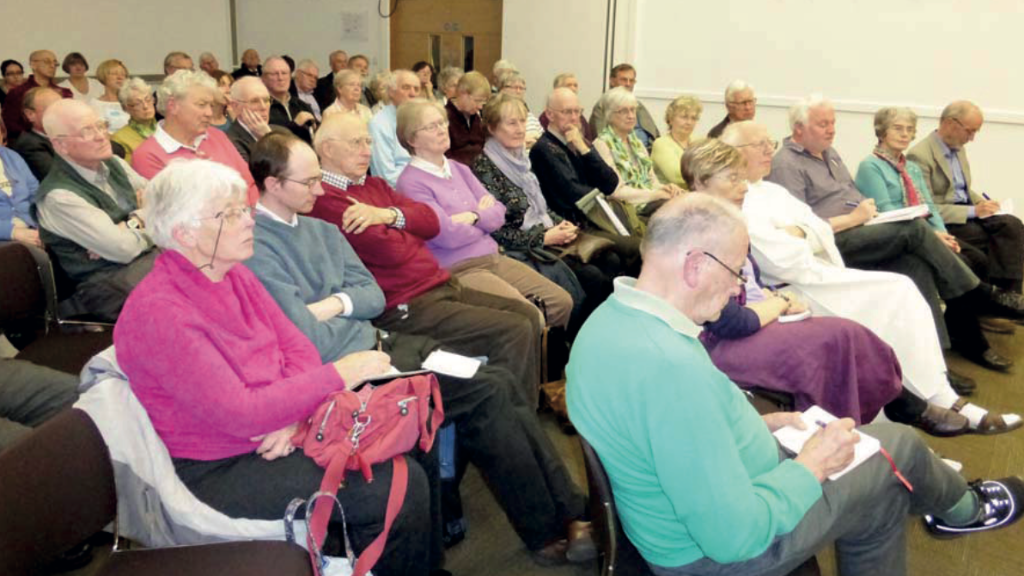
The audience at Friends' Meeting House
Finally, CST emphasises that political parties are tasked with offering effective ways for all citizens (beyond just the membership of a party) to contribute to the formulation of party policies. Attempts by the Conservatives to choose candidates through local primaries, and by Labour to engage policy ideas through meetings with non-members using community organising techniques, are interesting experiments in this area. However, given levels of apathy and disengagement the question remains: what else might be done?
Two missing points
Perhaps this formal analysis of the role of parties in the common good in CST is missing two things. First, the question of power and its distribution – or lack of distribution – in modern democracies; the fact that liberal democracies by their very nature, despite their aspirations, tend towards inequality rather than equality, and towards consolidations of power rather than dispersal of power. This does not inevitably mean that democracy is a sham, but perhaps that democracy needs to be self-reflexive – a bit humble and repentant even – and learn how to identify its own weaknesses and act upon them in the interests of something beyond and before it.
The second missing analysis relates to a historical awareness of the ways in which the mass movements of the 20th century brought about change in the basic conditions of justice and distribution. These movements are now in serious decline, or else all but gone: without such movements mobilising the wider body politic, it is hard to see where political renewal will come from. To act on the vision of the Common Good offered by CST would require mobilisation within communities with concrete enough focus to them that face-to-face communication about the good is possible.
As the political philosopher David Runciman has argued, if it is a question of mobilising the 99 per cent as a mass grouping my money is on the 1 per cent continuing to run the show. But perhaps the future lies wide open for those who are able to grasp what it might look like to explore relations with actual neighbours in the light of a vision of future neighbourliness.
Dr Anna Rowlands is Deputy Director of the Centre for Catholic Studies, Durham. This article is an edited and abridged version of her Manchester Newman Lecture which she gave on April 15th at Friends' Meeting House.
1 Interview with Michael Sandel in The Guardian, 27th May 2012.
2 http://www.prospectmagazine.co.uk/regulars/if-i-ruled-the-world-michael-sandel (last accessed 17/04/2015)
3 See the Pastoral Constitution of the Church in the Modern World: Gaudium et spes, #26
4 http://www.abc.net.au/religion/articles/2015/02/20/4183986.htm (last accessed 17/04/2015)
5 This section refers to Aquinas' 1267 letter to the King of Cyprus, On Kingship [De Regimine Principum]. See R.W. Dyson, Aquinas' Political Writings, Cambridge: Cambridge University Press, 2002.
6 See Hannah Arendt, The Human Condition, Chicago: University of Chicago Press, 1958.
7 See John Paul II's 1987 social encyclical: Sollicitudo Rei Socialis.
8 See David Hollenbach, The Common Good and Christian Ethics, Cambridge: CUP, 2002.
9 See Pope Francis' 2013 Apostolic Exhortation, Evangelii Gaudium.