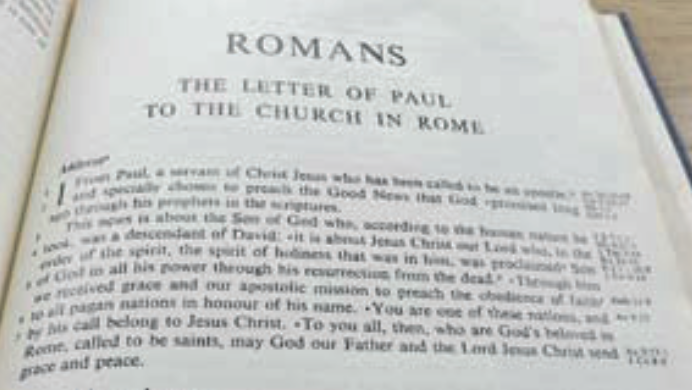
An exploration of Paul's Letter to the Romans – the longest, most influential and most rewarding of his letters – examining why he wrote it, its theological ideas, and its enduring significance for Christians today.
The letter of Paul that is heard more often than any other as the Second Reading on Sundays in the three-year Catholic lectionary is his Letter to the Romans. This letter is the longest, the most influential and the most rewarding of Paul's undisputed letters. It may well be the last that he wrote.
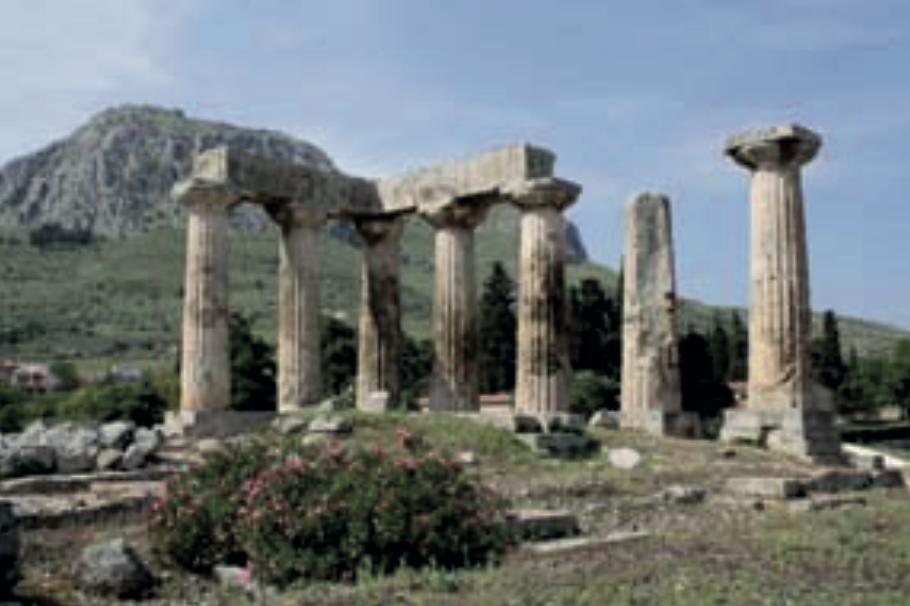
The ruins of a temple in Ancient Corinth
He seems to have written it in Corinth (in modern Greece) during his stay there recorded in Acts 20.3. Cenchreae was its port, where Phoebe was a deacon (Romans 16.1); and the Gaius mentioned in 16.23 may well be the Gaius whom Paul baptised in Corinth (1 Corinthians 1.14). It was written around AD 57; we cannot be sure of the exact year, but certainly it was written before the publication of any of the written Gospels.
Paul wrote to the Christian community in Rome (Romans 1.7). This was a Church he had never visited or evangelised; nonetheless, as "minister of Jesus Christ to the Gentiles" (15.16), he longed to see them (1.11). Rome was the most important city in his world; its government, through its representative Pontius Pilate, had executed Jesus in faraway Judea. The Christians of Rome, at the centre of the Roman Empire, had many contacts, especially with the churches in Judea (Acts 28.21). Luke, in Acts, describes Paul's eventual arrival in Rome as a prisoner (Acts 28.14).
Why write to the Romans?
Many have thought that, after more than twenty years in the apostolate, Paul thought it worthwhile to write a general essay about his theology; to provide a manifesto for the converts he had made and the assistants with whom he had worked (some of whom he lists in his final chapter). If this is correct the letter differs significantly from his others, which were all written in response to specific pastoral situations. Paul's preferred method of evangelisation was to visit a community personally (1 Thessalonians 2.17); if he was unable to do so he would send his delegate (1 Thessalonians 3.2). He had, over recent years, adopted a third method – that of writing letters (1 Thessalonians 5.27). If, then, he wrote to the Romans for no obvious pastoral reason this would be an innovation.
Others say that Paul wrote because he was a "minister of reconciliation" (2 Corinthians 5.18). The Roman Church could have been one of the oldest: Luke wrote in Acts that people from Rome had been among those who heard Peter preach on Pentecost day (Acts 2.10). Luke also reported that the emperor Claudius had expelled the Jews from Rome in AD 49, and these would have included Jewish Christians (Acts 18.2). This would have left the Christians of gentile origin by themselves in Rome. On the return of the Jewish Christians at the death of Claudius in AD 54, there would no doubt have been tensions and misunderstandings between Christians whose background was so different. Paul's words about the universal nature of God's all-inclusive plan for salvation, especially in chapters 9-11, would have been very relevant for a community of such diversity. The instructions that he gives about relationships between the weak and the strong in the matter of eating meat which had been used in idol worship would have addressed a particularly difficult area in the relationships of a community divided between Jewish and Gentile converts (14.13-23).
Another view is that he wrote out of self-interest, or rather out of interest in his apostolate. He mentions in the letter that he intended to go to Jerusalem to deliver a gift to the poor Christians there (Romans 15.25). Jerusalem was a Church which still held him in suspicion because of misunderstandings about his attitude to the Mosaic Law (Ac 21.21). He wanted the Romans to use their influence that he might be well-received there; he also wanted the support of the Romans for a projected visit to Spain.
Why Romans is Important
The Letter to the Romans is the most significant of Paul's letters theologically and historically. It has had an immense influence. In it, Paul did not speak only to the Christians of Rome and give them direction in areas that were troubling them. The fact that it was included in a collection of Paul's letters as a whole (2 Peter 3.15-16), meant that it was soon recognised as a valuable tool to assist Christians from other places in their understanding of the relationship between God's old and new covenants. These Christians would also deepen their understanding of the significance of the work of Christ in bringing the love and mercy of God to the whole of humanity.
There never has been a time in history when Christians have not had much to learn from this letter. In the fourth century the reading of two of its verses, Romans 13.13-14, provided part of the story of the conversion of St Augustine. In the Reformation period of the sixteenth century it was a major influence on Martin Luther, especially because of its teaching on 'justification by faith'. Karl Barth, an outstanding Protestant theologian of the early years of the twentieth century, wrote a major commentary on Romans. The importance of the letter for dialogue between the major religions is now being rediscovered.
Some Theological Ideas
The theology of the letter follows its structure. After a greeting and introduction, Paul defines the gospel of salvation which he preaches (1.1-17). The next chapters are concerned with three characteristics of God.
- We learn first about the necessary anger of God against the sinfulness of the world. No-one is exempt; Gentiles and Jews are equally guilty and God, who is good, must necessarily feel anger at the evil which distorts his creation. There is no human being who does not need salvation from this anger (1.16-3.19).
- God himself provides the means for this salvation because of his second characteristic, his righteousness. Because he is good, God finds a solution to the power of Sin that is destroying his creation. Through Jesus Christ God justifies us and redeems us. He brings about the expiation of our sin. By these means, the fulfilment of the promises God made long ago to Abraham is achieved.
- But there is a third attribute of God, namely the love of God. This is poured into the hearts of the believers (5.5). No longer does sin live within those who are 'in Christ'. Paul explains how, before the death and resurrection of Christ, the world was under the control of three tyrants: Sin, Death and the Law. The Law, though good in itself (7.12), was able only to point to sin but it could give no remedy for it.
The work of Christ destroyed the power of these tyrants and in their place the Holy Spirit dwells within the believer, so that a new quality of life is possible. Believers are now children of God, able to overcome all the wickedness in the world. If faith was a key word in the previous section, hope is the key word in these chapters. In two typical verses, it occurs five times (8.24-25). Paul ends this section with a wonderful cry, "Who can separate us from the love of God?" (8.39).
Hope (9.1-11.36)
"Everyone who calls on the name of the Lord shall be saved." (10.13)
God's love was truly for the whole of humanity. But Paul knew well enough that the people to whom he belonged, the Jewish people, had refused to accept Christ. Paul, "an Israelite, a descendant of Abraham, of the tribe of Benjamin" (11.1), becomes extremely personal in discussing his anguish about the fate of his own people, the Jews, who, despite their many privileges, refuse to accept this gospel (9.1-2). Employing many quotations from Israel's scriptures, Paul argues from the fidelity of God to the final salvation of his own people. He concludes with a verse quoted in the Second Vatican Council's discussions of the relationship between Christians and Jews, "the gifts and the calling of God are irrevocable". (11.29).
We now understand why Paul referred so often earlier in the letter to "to the Jew first and also to the Greek" (1.16). These chapters are a challenge to believers today, when members of major religions, despite their worship of the same God, are divided, and when even among Christians there is separation. For Paul, such complex problems are not beyond the outreach of God's mercy. The hope he preaches is offered to all God's creatures.
Love (12.1-15.13)
"All the commandments. . . are summed up in this single command: You must love your neighbour as yourself." (13.9)
The final chapters are very practical. How are we to live our daily lives against the reality of this saving gospel? The main point is that we live out a 'liturgy', in the sense that everything we do becomes part of our grateful response and worship of God. There is nothing that is not sacred in our lives. The attentive reader will notice parallels between what Paul has to say and what Jesus is reported to have said in the Sermon on the Mount (Matthew 5-7). He also echoes the words of Jesus to the scribe in the gospel when he writes that the commandments "are summed up in this word, 'Love your neighbour as yourself'" (Mark 12.31; Romans 13.9).
And then, at last, Paul comes to certain problems which he had heard existed in the Roman community: the conflict which split the 'weak' and the 'strong' because of their attitudes to eating meat which had been used in worship in temples which were dedicated to gods who were not gods at all.
Conclusion (15.14-16.27)
As he concludes the letter, Paul becomes friendly and personal. He admits that he has written 'somewhat boldly' to the Romans (15.15). He gives greetings to 28 individuals whom he knows in Rome (16.1-15). Perhaps he wanted them to speak out in favour of his request for their support for his projects in Jerusalem and Spain (15.24-25). This reminds us how Paul was not a somewhat grim individual evangelist, working alone, but the leader of a team. The concluding lines give us yet another hymn of praise to God's glory and a special blessing to all who read and hear the letter. We are all invited to reply to his 'Amen'.
A letter for all seasons
Catholics hear this letter up to 28 times in the course of the three-year Sunday lectionary cycle. It is considered relevant at all times of the Church's year. Sixteen of these extracts are read between Sundays 9 and 24 in Ordinary Time in year A. Four are read during Advent, three in year A and one in year B. Five are read during Lent, three in year A and one each in years B and C. Two are read on Trinity Sunday in years B and C; one is heard optionally on Pentecost Sunday in year C. Extracts are brief and struggle to do justice to the letter as a whole. The chapter which is almost read in full is chapter 8; this is welcome, because it is surely the favourite chapter of all who know Romans well and is especially valuable for what it has to say about the Holy Spirit.
However, because of various feast days, some Sundays in Ordinary Time drop out and as a result we do not hear some rewarding and significant passages of this letter. All the more reason, then, to set aside time to discover the riches of the letter for oneself. Charles Cranfield, the author of the two-volume International Critical Commentary on Romans, introduces the shorter version of his commentary with the words, "Having been seriously engaged with the Epistle for more than a quarter of a century, I still find it always fresh and cannot read it without delight". May we come to share his delight.
Peter Edmonds SJ is a member of the Jesuit community in Stamford Hill, north London. An original version of this article appeared in the Jesuit online publication www.thinkingfaith.org, and was the basis of a talk to the Manchester/N Cheshire Circle in March, 2015.